
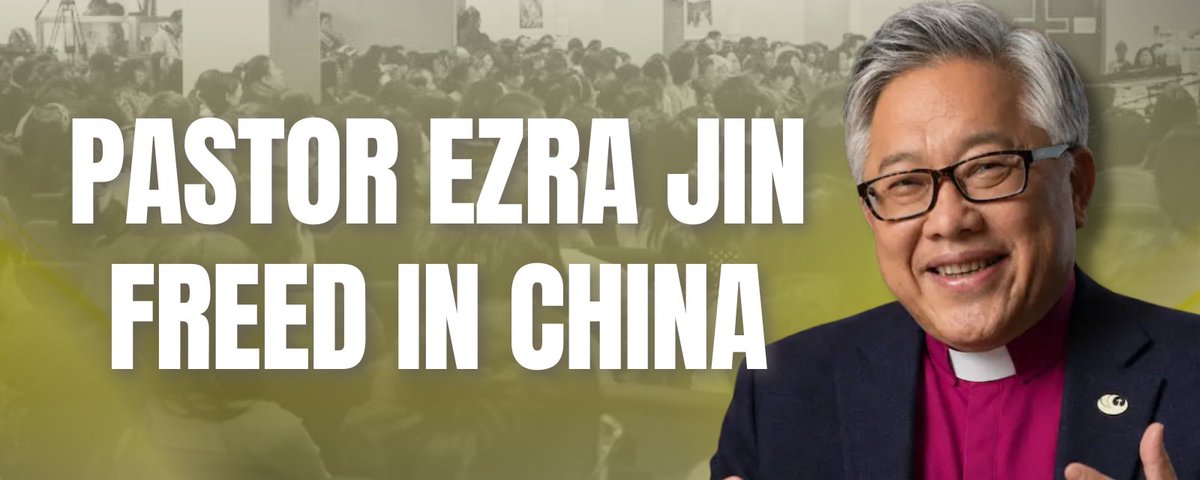
On July 4, an underground church pastor who had spent nine months in Chinese detention walked free onto American soil.
Pastor Ezra Jin Mingri, founder of Beijing's Zion Church, arrived in Los Angeles and reunited with his family shortly before Independence Day. His release did not come from a Chinese change of heart. It came after the President of the United States said his name to Xi Jinping.

What Beijing did
Jin was arrested on October 10, 2025, for practicing and sharing his faith and for his leadership as a pastor. He and 17 other Zion Church leaders were detained in what has been described as one of China's largest crackdowns on a single church in decades.
Authorities had already shut Zion's physical premises in 2018, but the church kept operating online, reaching thousands of worshippers — which is precisely why it was targeted. Jin had refused to register Zion with the state; he and nine other leaders were charged with "running illegal business operations."
That is the tell. A house church that would not submit to state control was prosecuted not for any crime of violence but for the administrative offense of existing outside the Party's reach.

The lever that worked
Here is what a democracy's leverage looks like when it is actually used.
At a May summit in China, President Trump raised Jin's case directly with Xi Jinping. Jin's family thanked the Trump administration for its leadership and said they believed his release could not have happened without that direct intervention. Jin's wife, Anna Liu, thanked Xi, Trump, Secretary of State Marco Rubio, and the 44 U.S. lawmakers who had signed a joint statement calling for his release.

Congress had built the pressure in the open. On May 13, 2026, the House passed H.Res.1259 by unanimous consent, a resolution urging the President to prioritize securing the release of Pastor Jin Mingri — along with Pastor Gao Quanfu and his wife Pang Yu, Dr. Gulshan Abbas, and Jimmy Lai — in his engagements with Xi Jinping. The Senate passed a companion resolution the same day.
Named. Prioritized. Pressed at the highest level. Released. That is the sequence, and it is not a coincidence.
The glass jaw
The lesson is one that religious-freedom advocates have argued for years: faith is the Chinese Communist Party's greatest weakness, not its afterthought. A regime that governs 1.4 billion people cannot tolerate ten thousand Christians logging on to worship — so it disappears their pastor and charges him as a swindler. Strength does not behave that way. Fear does.
That is why a single name, spoken by a president who chose to spend the capital, could pry open a cell that condemnation alone never would. The Party guards this pressure point precisely because it knows how exposed it is.
The crackdown has not ended
One release is not a victory, and Beijing has made sure no one mistakes it for one.
Freedom House welcomed Jin's freedom while stressing that other Zion Church leaders and members remain detained and that others still face serious criminal charges.

Anna Liu called for the release of the eight other Zion Church leaders still in custody. And within days of Jin's arrival in the United States, Chinese authorities denied bail to another detained Zion member, preacher Wu Qiuyu, held since October 2025 — an unmistakable signal that the campaign against the church continues.
Xi released the man Washington named. He kept the ones it did not.
What Washington should do
The takeaway for U.S. legislators is not sentimental. It is operational.
Naming works. The prisoners the United States lists, prioritizes, and raises at the summit table are the prisoners who come home. The ones left off the list stay in the cell. If a single resolution and one presidential ask freed Jin Mingri, then the eight Zion leaders still held, Pastor Gao Quanfu and Pang Yu, Dr. Gulshan Abbas, and Jimmy Lai are not beyond reach — they are simply waiting to be named with the same insistence.
A government that jails a pastor for worshiping online is not projecting confidence. It is protecting a glass jaw. The question for Washington is whether it will keep aiming there — case by case, name by name — until the cells are empty.
Which name goes on the list next?
