

"No one took up the question of why the Family Federation was bad. It was all impressions, reporting full of adjectives." — Kato Fumihiro

After former Prime Minister Abe Shinzo was assassinated in July 2022, Japanese media covered the Family Federation for World Peace and Unification (Unification Church) almost daily, naming lawmakers' ties to the group and calling it a "cult," but saying little about what illegal acts those ties actually led to.
Writer and media analyst Kato Fumihiro examined this coverage with data, and concluded it ran on a "cycle of agitation," in which activists, the media, and the public worked each other up and dressed up the excitement of a small group as nationwide "public opinion."
The following is based on his interview for the Universal Peace Federation (UPF Japan).
Called bad, but the reason was never explained

The reporting barely explained what the Family Federation had actually done, or why it was bad.
This was the first thing Kato noticed when he analyzed the coverage with numbers.
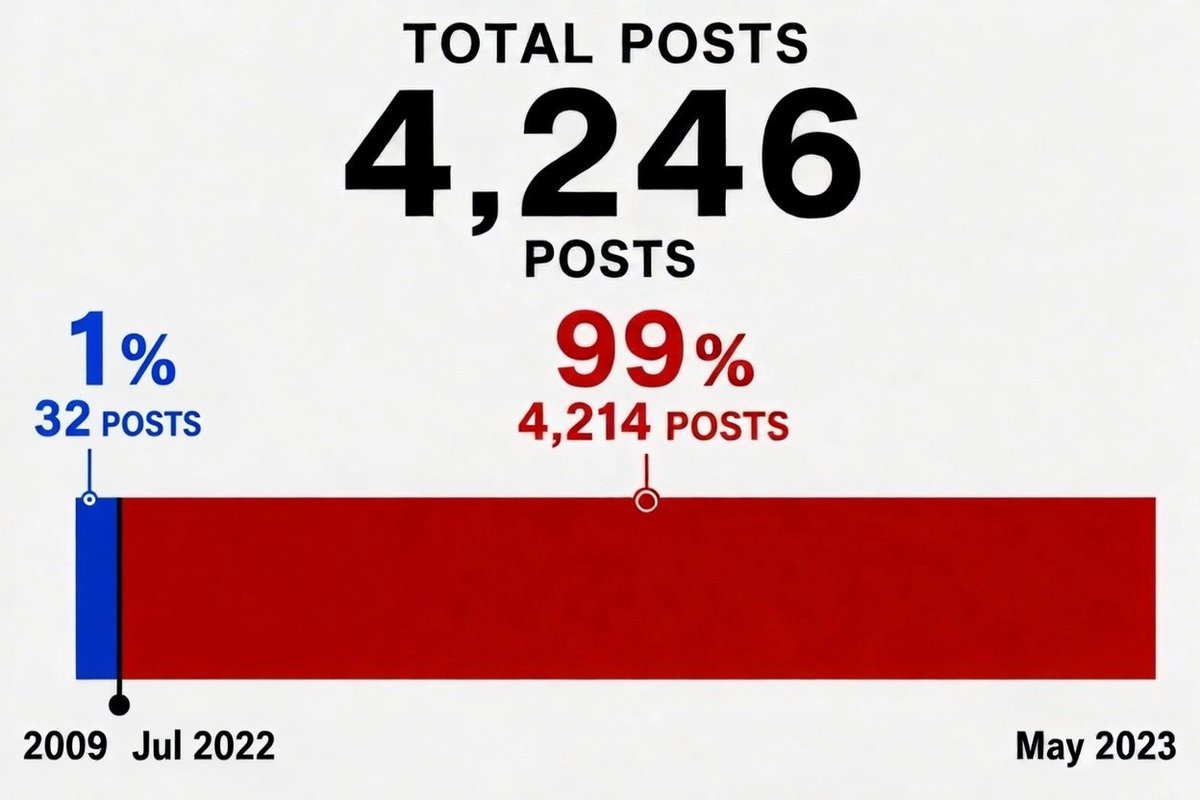
Looking at the posts of 11 major news organizations, he found 4,246 posts mentioning the Unification Church from 2009 to May 31, 2023. Of those, 99 percent (4,214 posts) came after the Abe assassination.
The coverage was a reaction to the killing, not the result of years of careful reporting.

Kato's method is very simple.
He collects newspaper articles in order over time, without adding his own opinions. Then he breaks the articles down into individual words and analyzes, all in numbers, which words appear, how often, and how they connect to other words. It is the opposite of the old approach of collecting impressions and photos.
Overnight, it became "a political story"
The direction of the coverage changed sharply within just a few days.
Kato traces the shift in the reporting right after the assassination.
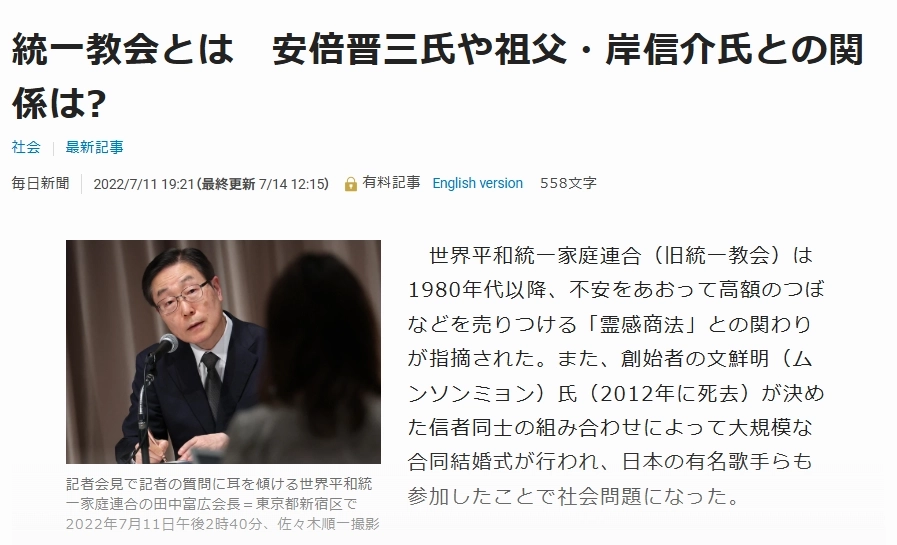
From here, the topic shifted all at once, from the suffering of "second-generation believers" to the relationship between politics and religion.
The problem is that while the coverage was filled with the real names and titles of lawmakers, it never said what laws or policies those connections had produced. Loose, "deeply tangled" ties such as exchanging business cards or attending meetings were lined up, with no explanation of why they were bad or whether they were illegal.
Adjectives stood in for evidence
When reporting could not point to a law that had been broken, it used adjectives instead. That is Kato's view.
The words used in the coverage also became the target of Kato's analysis. When he analyzed the reporting on the Family Federation's mass weddings, both from 30 years ago and after the assassination, the number of adjectives was unusually high.
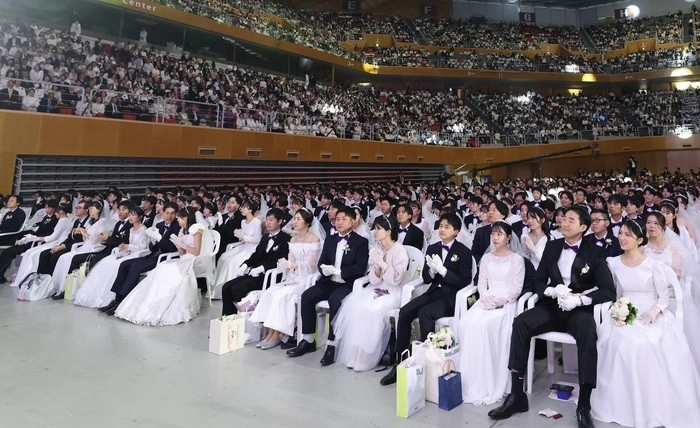
Normal reporting tries to use as few adjectives as possible, in order to stay objective. But the Family Federation coverage used a lot of old-fashioned, emotional adjectives like urawakai (youthful and lovely), creating a mood that something ominous was happening without ever pointing to a specific violation of the law. If there had been a clear violation, a reporter would have written it. Because they could not, adjectives were used instead.
The media also kept using the group's old name, "Unification Church," instead of its current legal name. Kato sees this as a way to bring back the impressions people had from 30 years ago.
The "wide show" as a device

A type of program unique to Japan, made for spreading gossip, made the uproar bigger.
Kato points to the role of the "wide show," a place where stories that major news programs find hard to handle get aired in a gossipy way. These are programs that gather whatever information the station has on hand, in order to fill time slots where ratings are hard to get. They look like news, but their real goal is to excite viewers.
The people with the most influence on the Family Federation issue were lawyers, figures who had drawn attention, and scholars of religion. But Kato points out that none of these three had directly interviewed believers or leaders of the group. They only talked to people who had left the faith and regretted it, or to people connected to them, and that became the "facts" used to describe the Family Federation.
The cycle of agitation

Activists, the media, and the public work each other up, and it can't be stopped. This is the cycle of agitation at the center of Kato's analysis.
Kato first came up with this idea when he was studying the reporting on the 2011 Great East Japan Earthquake and the Fukushima Daiichi nuclear accident. Activists spread claims of harm, the media picks them up, and public anxiety rises.
That anxiety creates support and donations for the activists, which makes their activity even more active. It is a structure in which the extreme claims of a few people spread through the media as if they were the truth for everyone.
The same structure fit the Family Federation case too. Activists told stories of harm, the media spread them as fact, anxiety and anger rose, and politicians who saw their approval ratings fall cut ties with the group and moved toward dissolution. In Kato's view, Prime Minister Kishida Fumio cut ties with the Family Federation to deflect criticism, and went ahead with the request to dissolve it.
There is also an example of a claim that spread without ever being checked. A lawyer publicly claimed that there was a group inside the Family Federation called the "Solomon faction" that made believers engage in prostitution. But no matter how much Kato investigated, he could not find any trace of such a group. It was not being hidden. It simply did not exist. It is an example of how an unverifiable claim can slip straight into the news.
Was the "public opinion" real?
It looked like the whole country was angry, but the data did not back that up.
To check whether the reporting really reflected public opinion, Kato looked at viewing data. When he broke down the ratings of the wide show Miyaneya, using the NHK ratings during Abe's state funeral as a baseline, here is what he found:
To check whether the reporting really reflected public opinion, Kato looked at viewing data. He broke down the ratings of the wide show Miyaneya*, using the ratings of NHK (Japan's public broadcaster) during Abe's state funeral as a baseline. Here is what he found:
(*Miyaneya is one of Japan's leading "wide shows," an early-afternoon program that mixes news and gossip in a talk-show format.)

In other words, the number of people who newly latched onto this topic was only about 2% of all households.
Google search data also showed that interest rose sharply in July 2022 and then quickly fell. By region, the interest was concentrated only in Nara Prefecture, where the incident happened, and parts of the greater Tokyo area. What looked like nationwide public opinion was actually the excitement of a small, geographically lopsided group, and it was amplified by social media and the news until it was mistaken for the will of the entire nation. That is Kato's argument.
The pressure to conform that silenced other views

Pressure fell on anyone who tried to offer a different view.
According to Kato, when the comedian Ota Hikaru raised a problem on a panel program, that Family Federation believers were being confined against their will and forced to give up their faith, he was criticized. A female journalist who had broken major stories in the past called him a "spokesman for the group." That label worked as a kind of social punishment and silenced other commentators.
Believers themselves faced even stronger pressure, Kato says. There are accounts of people being refused medical treatment when their insurance card showed a workplace tied to the group, and of people being denied renewal of their credit cards.
What kind of runaway reporting was it?
To sum up Kato's analysis, this is what the coverage of the Family Federation after the Abe incident looked like.
Without ever showing what was illegal, the Family Federation was described only through impressions like "cult," "money-grubbers," and "fraudulent faith." The names and titles of lawmakers were lined up, and simply having contact was treated as proof of evil.
Adjectives overflowed, and the name "Unification Church" brought back memories from 30 years ago.
Wide shows consumed it as gossip, and activists supplied one new topic after another, so the cycle never stopped.
And even though that excitement actually belonged to only a small group, it was made to look like the will of the whole nation.
What Kato points to as most dangerous is this faking of public opinion. Claims that could not be verified spread as fact, fake public opinion moved politics, and it went all the way to the dissolution of a religious organization.
It was not what really happened, but what looked like it happened, that moved the reporting and the politics.