

A Review of Evidence Presented in "December 3, 2024 — The Hidden Truth" Jeon Han-gil News Documentary (2 hrs 21 min)
On December 3, 2024, South Korean President Yoon Suk-yeol declared emergency martial law. It was lifted six hours later. He was impeached within days and removed from office by the Constitutional Court. Opposition leader Lee Jae-myung — who was standing criminal trial for election law violations and fraud at the time — won the subsequent snap presidential election on June 3, 2025.
A widely viewed documentary by Jeon Han-gil News compiles evidence from government audits, court proceedings, National Assembly testimony, whistleblower accounts, and statistical analysis to raise questions about the integrity of South Korea's election system, the independence of its judiciary during the impeachment process, and the systematic use of legislative power to dismantle executive branch functions prior to the martial law declaration.
This report presents the key evidence from that documentary in a format intended for policymakers in allied democracies. South Korea hosts 28,500 U.S. troops, anchors America's Indo-Pacific alliance structure, and is home to the world's most critical semiconductor manufacturing infrastructure. The democratic legitimacy of its government is a matter of direct U.S. national security interest.
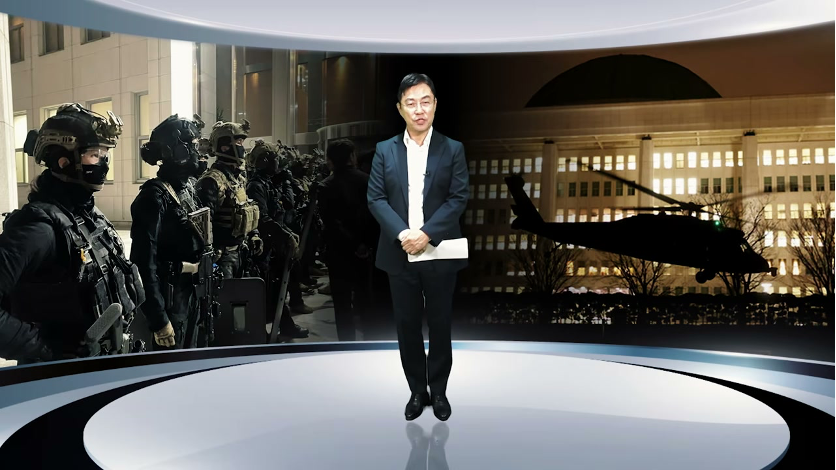
PART ONE: ELECTION DATA ANOMALIES
The documentary's central evidentiary pillar is statistical. It examines the relationship between early voting results and election-day results across multiple election cycles and identifies a pattern that begins in 2020 and has persisted in every subsequent election.
Baseline: 2016 General Election
In the 2016 (20th) general election — the last election before the anomalous pattern appeared — early voting and election-day results were statistically consistent. The difference between a candidate's early vote share and election-day vote share was small (1-6 percentage points), random in direction, and varied by district. This is the expected statistical behavior in any election where both voting methods draw from the same population.
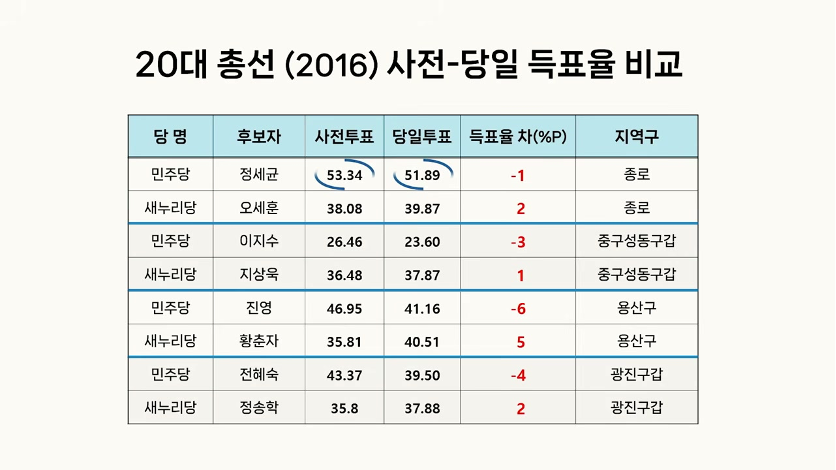
2016 general election: Early voting (사전투표) vs. election-day voting (당일투표) by candidate and district. Differences are small, random in direction, and vary by location — consistent with expected statistical behavior.
2020 General Election: A Uniform Shift
In the 2020 (21st) general election, a different pattern emerged. Across Seoul, the Democratic Party's early voting share exceeded its election-day share by 12.79 percentage points. The conservative party's early voting share was 12.79 percentage points lower than its election-day share. The figures are symmetrical to three decimal places.
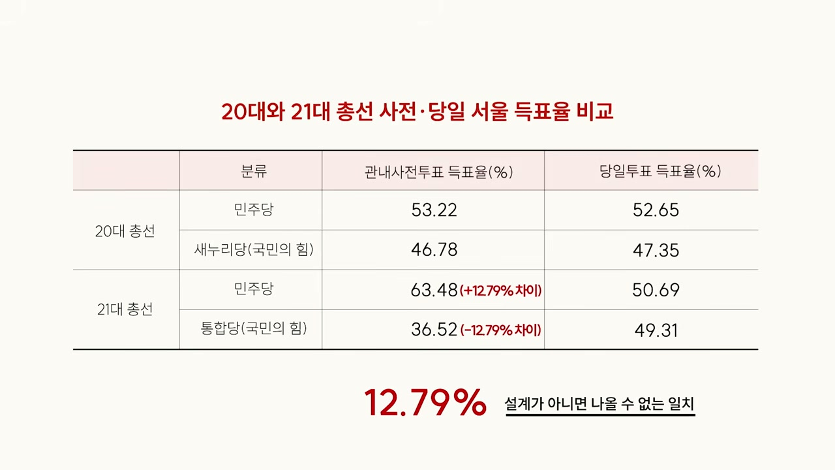
Comparison of 20th (2016) and 21st (2020) general elections in Seoul. In 2016, early and election-day results were nearly identical (difference of ~0.5%). In 2020, a 12.79% gap appeared — identical for both parties in opposite directions. Bottom text: "A match this precise cannot occur without design" (설계가 아니면 나올 수 없는 일치).
The Democratic Party's standard explanation is that its supporters prefer early voting. If true, higher early voting turnout should correlate with higher Democratic vote share. The documentary presents data showing the opposite: in districts with the highest early voting turnout, the Democratic Party's vote share was often lower. The explanatory framework offered by the party does not align with its own data.
The 2020 election produced an overwhelming Democratic supermajority:
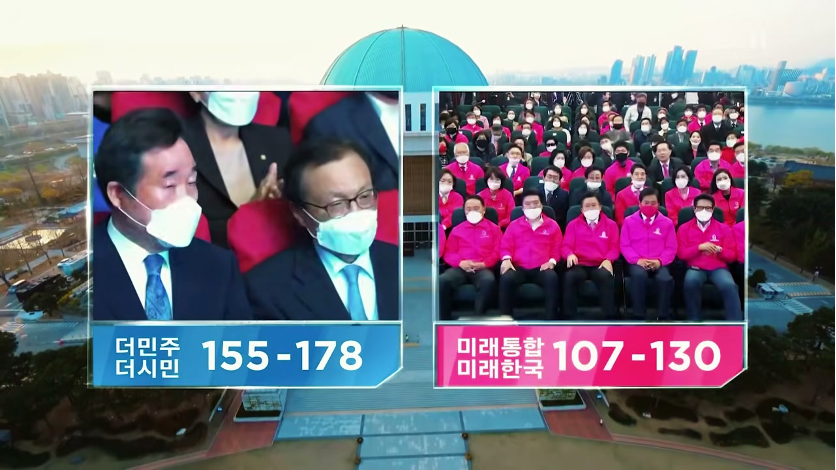
2020 (21st) general election results. Democratic coalition: 155-178 seats. Conservative coalition: 107-130 seats.
Nationwide District Analysis
South Korea has 3,551 individual voting districts. In a statistically normal election, the direction of the early-vs-election-day difference should be approximately random — roughly half favoring each party. The documentary presents the actual distribution:
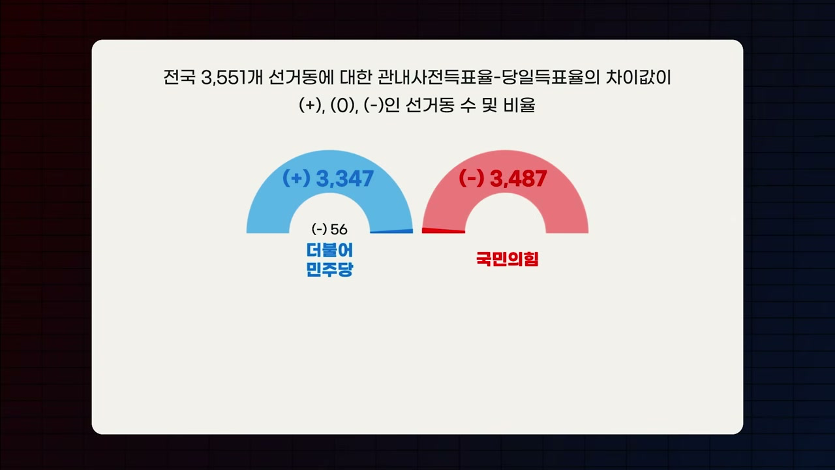
Of 3,551 voting districts: 3,347 (+) showed the Democratic Party performing better in early voting than on election day. 56 (0) showed no difference. The conservative People Power Party showed the inverse: 3,487 (-) districts with lower early vote share. Only 56 districts showed parity.
In 94.3% of districts, the Democratic Party's early voting share exceeded its election-day share. In 98.2% of districts, the conservative party's early voting share was lower. A uniform directional pattern across 3,551 geographically diverse districts is inconsistent with random voter behavior.
Individual District Charts: 52 Contested Results
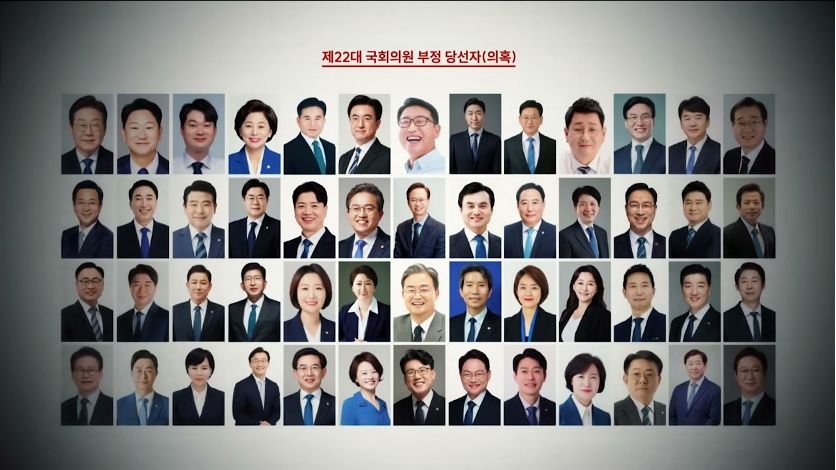
The documentary identifies 52 Democratic Party members of the 22nd National Assembly (elected April 2024) whose district-level results display the early voting anomaly. Statistical analysis indicates that if these 52 results were reversed, the People Power Party would hold 142 seats — a governing majority.
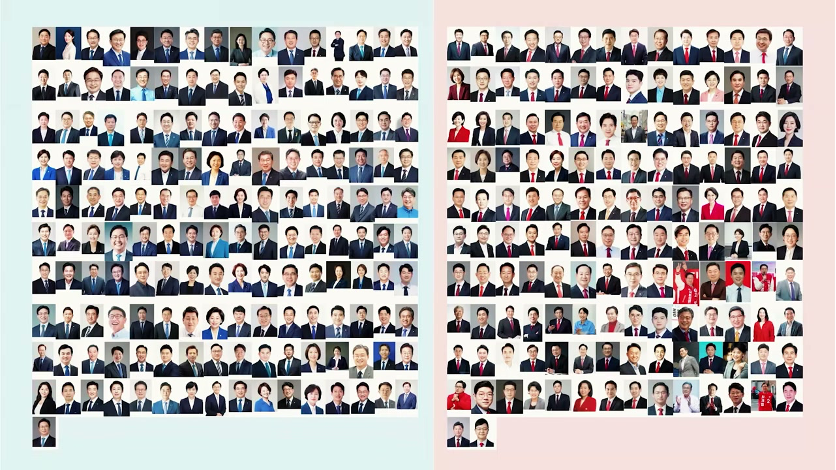
52 members of the 22nd National Assembly whose election results show statistically anomalous early voting patterns. Title: "22nd National Assembly — Suspected Fraudulent Election Winners" (제22대 국회의원 부정 당선자(의혹)).
District-level charts illustrate the pattern:

Gyeonggi Hanam-Gap, 22nd General Election (2024). Blue = Democratic candidate. Red = conservative candidate. Left portion = early voting precincts. Right portion = election-day precincts. The Democratic candidate leads by 15-20 points in early voting; the margin collapses to near-parity on election day
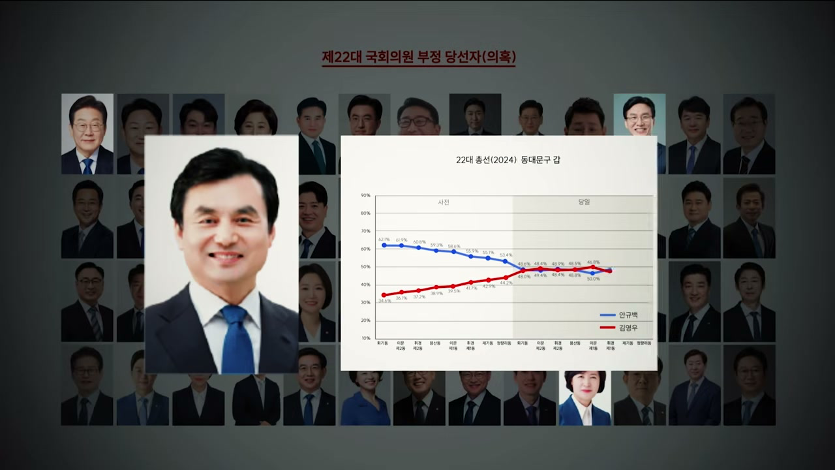
Dongdaemun-Gap, 22nd General Election (2024). The conservative candidate (red, Kim Young-woo) overtook the Democratic candidate (blue, An Gyu-baek) on election day. An Gyu-baek won overall due to a 62.1% to 35.4% early voting margin that reversed to near-parity on election day.
The 2022 Presidential Election
Yoon Suk-yeol won the 2022 presidential election by 0.73% — approximately 247,000 votes — defeating Lee Jae-myung. The early voting data shows Lee outperforming his election-day numbers across every region of South Korea, consistent with the pattern observed in the general elections.

2022 presidential election: Early voting (사전, dark line) vs. election-day (당일, light line) by region. The Democratic candidate's early vote share consistently exceeds his election-day share across all regions.
The documentary's interpretation: the early voting manipulation was calibrated for a narrow Lee Jae-myung victory, but Yoon's election-day performance exceeded projections by a sufficient margin to overcome the advantage. This would explain the narrow result.
The June 3, 2025 Presidential Election
In the June 3, 2025 snap presidential election following Yoon's removal, conservative candidate Kim Moon-su won election-day voting by approximately 15 percentage points. He lost the election by 2.89 million votes. The early voting margin favoring Lee Jae-myung was approximately 40 percentage points — the largest early-vs-election-day gap in South Korean electoral history.
Z-Value Analysis
Z-value analysis measures how many standard deviations a result falls from the expected mean. It is a standard tool in inferential statistics for determining whether an observed result could have occurred by chance. The higher the Z-value, the less likely the result is natural.
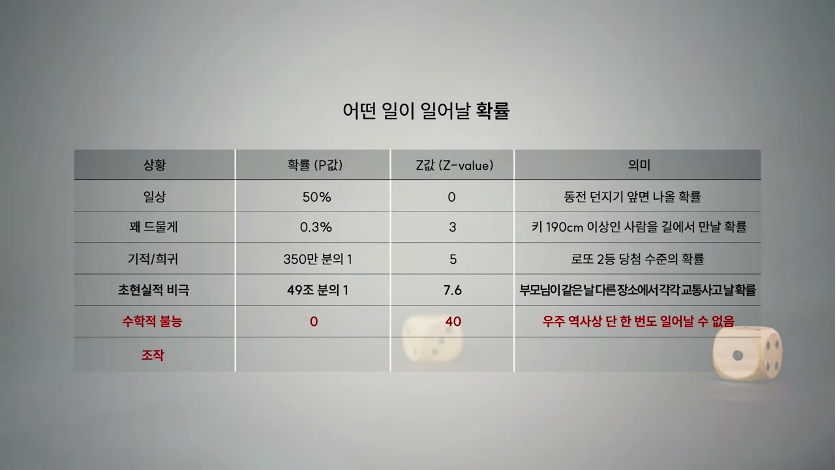
Z-value reference table from the documentary. Everyday occurrence (coin flip): Z=0. Fairly rare (meeting someone over 190cm): Z=3. Miracle-level (lottery 2nd prize): Z=5. Both parents dying in separate accidents same day: Z=7.6. "Mathematically impossible" (red): Z=40 — "could not occur once in the history of the universe." Below: "Manipulation" (조작).
Z-values calculated for the early-vs-election-day voting differential:
21st General Election (2020): Z = 40 22nd General Election (2024): Z = 42 June 3, 2025 Presidential Election: Z = 1,500
For reference: a Z-value of 7.6 represents the probability of both parents dying in separate, unrelated traffic accidents on the same day. A Z-value of 40 represents an event that could not occur once in the history of the observable universe. No natural dataset in any field of science has produced a Z-value of 1,500.
Statistics expert interviewed in the documentary. Subtitle: "Phenomena that are probabilistically difficult to occur cannot all happen simultaneously" (확률적으로 일어나기 힘든 현상들이 동시에 일어날 수는 없다).
"In my classroom, I teach students that a Z-value above 2 means the samples come from different populations. That is a textbook exercise. A Z-value of 40 — I have never seen that in my career. It cannot come from the same population of voters." — Statistics professor, interviewed in the documentary
— — —
PART TWO: INSTITUTIONAL VULNERABILITIES AND SUPPRESSED INVESTIGATION
National Election Commission: Security Audit Findings
From July to September 2023, the National Intelligence Service (NIS) conducted a penetration test of the NEC's election systems. The findings were reported to the National Assembly and are a matter of public record.
Key findings: 1. Vote sorting machines were vulnerable to manipulation via unauthorized USB devices. A hacking program installed via USB could cause ballots marked for Candidate A to be classified as votes for Candidate B. 2. The internal network, election network, and external internet — designed to be isolated — contained connection points that allowed cross-infiltration. 3. The integrated voter registry system was accessible from outside the NEC. 4. The system architecture permitted the creation of fraudulent voter records ("ghost voters") and mass printing of counterfeit ballot papers.
"It was worse than I expected. The level of vulnerability was significantly below adequate. If an attack on the election system occurred immediately after a ceasefire, it could cause social chaos. The vulnerabilities need to be addressed urgently." — NIS official, National Assembly testimony
NEC Internal Whistleblower Testimony
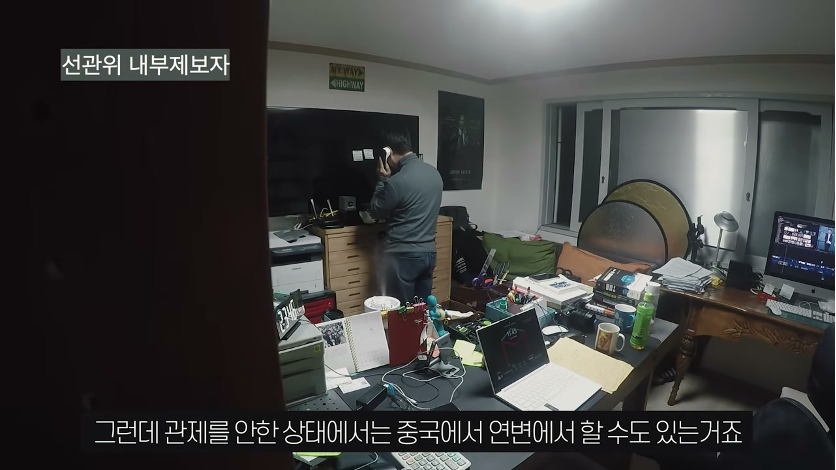
NEC internal whistleblower, identity protected. Upper-left label: "NEC Internal Whistleblower" (선관위 내부제보자). Subtitle: "Without security monitoring, it could be done from China — from Yanbian" (그런데 관제를 안한 상태에서는 중국에서 연변에서 할 수도 있는거죠).
The NEC maintained publicly that its systems were under 24/7 security monitoring. An internal whistleblower, whose identity is protected in the documentary, provided a different account: security monitoring was not operational during election periods.
"Why didn't they include the security monitoring team during elections? If you include monitoring, they detect intrusions. But without monitoring — China could connect and do it. From Yanbian. Yes. It's possible." — NEC internal whistleblower
NEC Secretary-General Testimony Before the National Assembly
Under questioning by legislators, the NEC's Secretary-General acknowledged that the internal and election networks were connected during early voting periods — directly contradicting the NEC's longstanding public position that its systems were completely isolated from external networks.
"The network separation issue involves the business network and the election network. This requires significant budget, so we are pursuing it as a medium-term project. The integrated voter system cannot operate without connection during early voting. During the test day before early voting and during the two early voting days — those are the only times it is connected." — NEC Secretary-General, National Assembly testimony
A legislator responded: "You just said network separation is insecure. If a hacking organization targets the system during those connected days, we are breached. This is an urgent matter." The Secretary-General agreed that network separation was necessary. The budget was never allocated.
Why the NEC Has Never Been Independently Investigated
The NEC is constitutionally independent under Article 114 of the South Korean Constitution. No prosecutor, police force, or executive branch agency has jurisdiction to compel an investigation of its operations, subpoena its records, or seize its servers. Every election fraud lawsuit filed in South Korean courts has been dismissed. No court has issued a warrant to examine NEC servers or open ballot boxes for verification.
This institutional reality is central to understanding why martial law troops were deployed to the NEC on December 3 — and why they constituted a larger force (approximately 300) than those sent to the National Assembly (approximately 280), arriving 78 minutes earlier. The NEC was the primary operational objective.
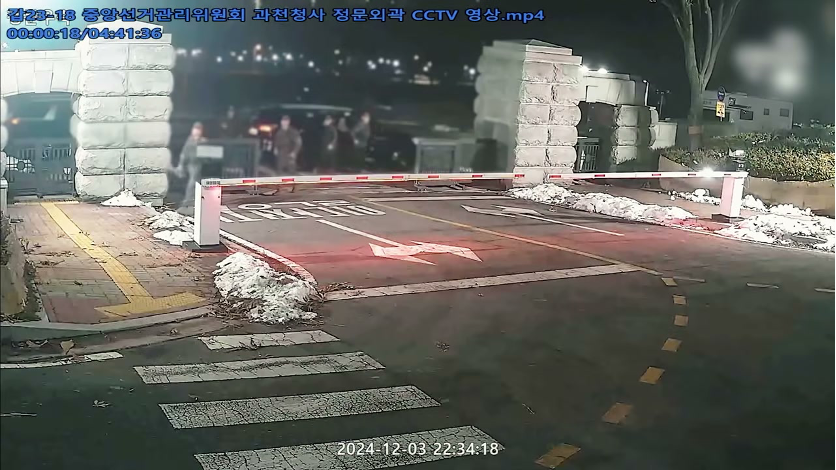
CCTV footage: Martial law troops entering the NEC's Gwacheon headquarters at 22:34 on December 3, 2024 — 78 minutes before the National Assembly operation. The CCTV timestamp is visible at bottom: 2024-12-03 22:34:18.
Nineteen Defense Intelligence Command agents entered the NEC server room. A military truck arrived to transport servers for forensic analysis. Separately, 47 troops secured the Public Opinion Survey Review Committee facility in Gwanak — the body responsible for managing exit polls and election surveys. When martial law was lifted six hours later, all troops withdrew. No servers were seized. No forensic analysis was conducted. No ballots were examined.
The Druking Case: Adjudicated Opinion Manipulation
One case of organized election-era opinion manipulation in South Korea has been fully adjudicated. In 2018, Kim Dong-hun ("Druking") was convicted of operating a macro system called "King Crab" that could mass-manipulate online comments, trending topics, and approval polls. He worked with Kim Kyung-su, governor of South Gyeongsang Province and one of President Moon Jae-in's closest political allies.
Court records established that the operation manufactured online narratives during the 2017 presidential campaign. Druking's team claimed credit for shaping public perception of Moon Jae-in's TV debate performances and for "dominating online opinion" after the election. Kim Kyung-su was convicted and imprisoned.
First Lady Kim Jung-sook was documented participating in events organized by Druking's affiliated group during the campaign. This is the only proven, convicted case of organized election-era opinion manipulation in South Korean history — conducted by associates of the party that now controls all branches of government.
Additional Concern: NEC Staffing Patterns During Elections
Internal records cited in the documentary indicate that NEC staff took mass leave during election periods. In March 2022 — during both the presidential election and local elections — the number of staff on leave reached 209, a historical high. The NEC responded by conducting emergency hiring of 152 contract workers to fill gaps. The documentary raises questions about whether critical institutional knowledge and oversight were absent during the most sensitive operational periods.
— — —
PART THREE: INSTITUTIONAL PATTERN — LEGISLATIVE POWER AND EXECUTIVE REMOVAL
The documentary identifies a recurring sequence of events across two administrations that it characterizes as a repeatable methodology for regime change using legal and institutional mechanisms.
Use of National Tragedy as Political Catalyst
In 2014, the Sewol Ferry disaster killed 304 people, including 250 high school students. The national grief was channeled into a sustained political campaign targeting President Park Geun-hye personally, centered on allegations about her whereabouts during a seven-hour period on the day of the sinking.
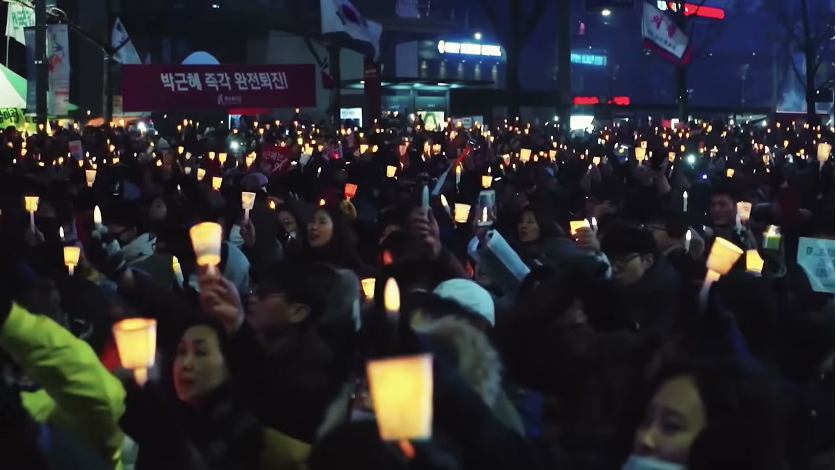
2016 candlelight protests preceding Park Geun-hye's impeachment. Banner: "Park Geun-hye — Immediate and Complete Resignation" (박근혜 즉각 완전퇴진). These protests drew millions of participants.
In 2022, the Itaewon crowd crush killed 159 people. A similar mobilization pattern emerged: candlelight vigils converted to political protests, identical slogans deployed, marches directed at the presidential office.
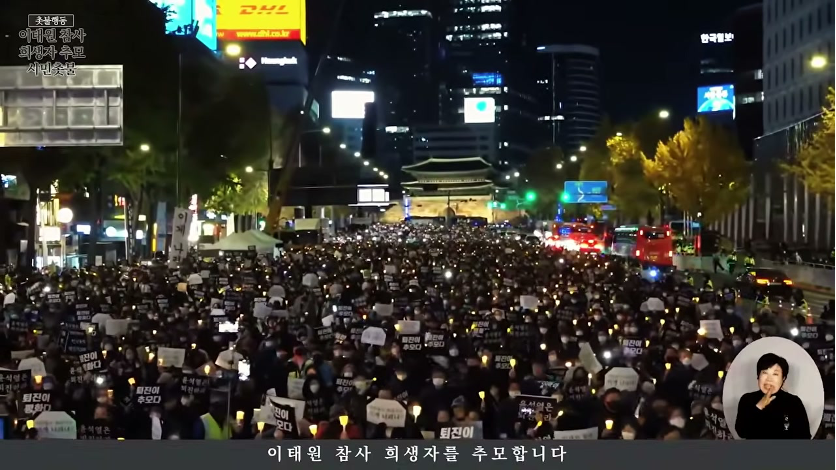
2022 Itaewon disaster candlelight protests. Subtitle: "Memorializing the victims of the Itaewon disaster" (이태원 참사 희생자를 추모합니다). Protest signs demanded presidential resignation, using language identical to the 2014 Sewol-era protests.
The Itaewon mobilization was disrupted when South Korean intelligence agencies uncovered that a former Korean Confederation of Trade Unions (KCTU) official had received operational directives from North Korea instructing the weaponization of the disaster. The directives included specific protest slogans:
"Maximize the outpouring of rage. Combine the November-December struggle with candlelight protests. Use the slogans: "The people are dying," "Is this a country?," "Resignation is the memorial."" — North Korean directive — agent convicted and sentenced to 15 years imprisonment
Evidence Fabrication Allegations in Both Impeachments
The Park Geun-hye impeachment (2016-2017) was precipitated by JTBC's report on a tablet allegedly belonging to presidential confidante Choi Soon-sil. Subsequent trial proceedings established that the device belonged to Blue House administrator Kim Han-su. Former Prime Minister Hwang Kyo-ahn confirmed publicly that the tablet was never admitted as evidence in court.
"The tablet — do you still believe it was fabricated? It wasn't admitted as court evidence. Look into it yourself. It was not admitted. If it were legitimate, it could not have been excluded." — Hwang Kyo-ahn, former Prime Minister and Acting President
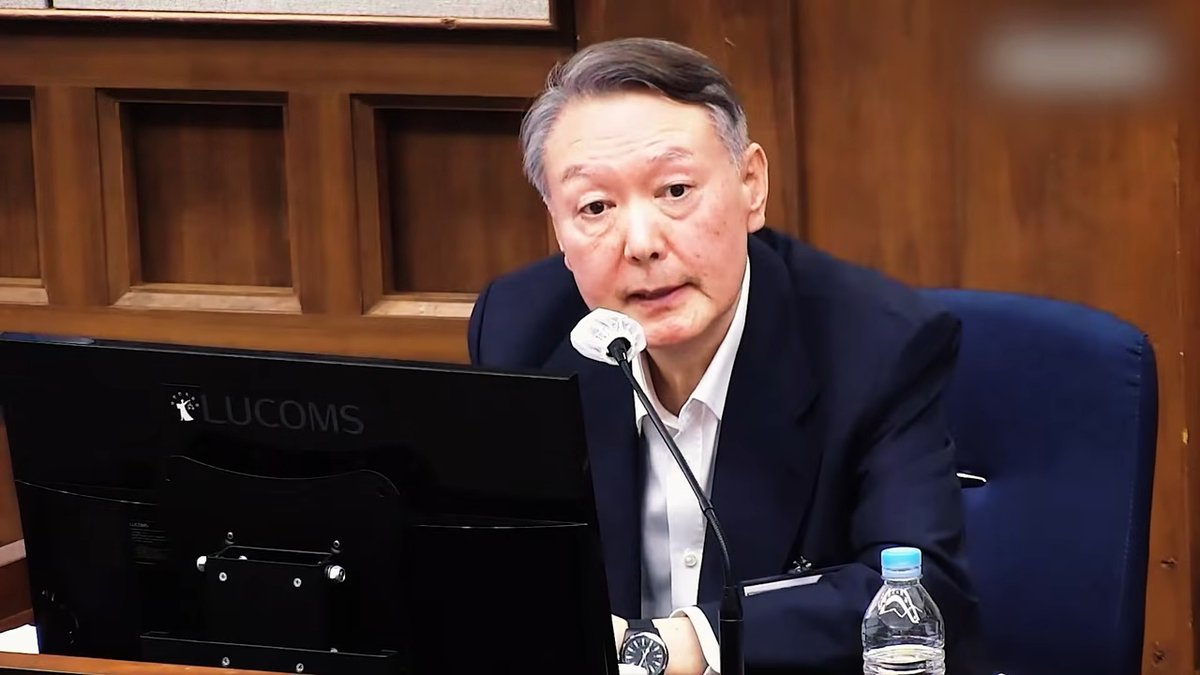
The Yoon Suk-yeol impeachment (2024-2025) relied heavily on a handwritten memo allegedly documenting presidential orders to arrest lawmakers, and on testimony from Special Warfare Commander Kwak Jong-geun regarding a phone call from the president.

Special Warfare Commander Kwak Jong-geun (right, in uniform) testifying at the National Defense Committee. His testimony regarding the president's phone call shifted on key details during questioning.
Issues identified with the evidence: • Kwak's testimony shifted on the central question of whether the president used the word "legislators" (의원) or "personnel" (인원). He acknowledged that his recollection of specific details came not from his own memory but from subsequent conversations with others. • The initial "handwritten" memo presented as evidence was sourced from the internet, not composed at the scene. • A handwriting analysis commissioned by media figure Byun Hee-jae, conducted by a retired National Forensic Service examiner with over 30 years of experience, found that handwriting on the key memo was consistent with that of Democratic Party lawmaker Park Soon-won — whose office had been actively investigating martial law preparations for months prior to December 3. • The Constitutional Court declined defense requests to call the witness who could verify the memo's provenance. • The "insurrection" charge — the basis of the impeachment — was removed from the trial to expedite the ruling.
Formal impeachment charges against President Yoon: Insurrection (Criminal Code Article 87), Abuse of Power (Article 123), Obstruction of Official Duties (Article 144). The insurrection charge was subsequently removed from the trial.
The documentary notes a constitutional law point: in the history of constitutional governance, no head of state has been convicted of insurrection for exercising emergency powers granted by their own constitution.
Serial Impeachments: Executive Branch Paralysis
Prior to the December 3 martial law declaration, the Democratic Party — holding a legislative supermajority — filed 29 impeachment motions against executive branch officials. Thirteen were passed by the National Assembly. Targets included the Interior Minister, prosecutors handling cases against Lee Jae-myung, the Board of Audit chairman, and three successive chairs of the Broadcasting and Communications Commission.
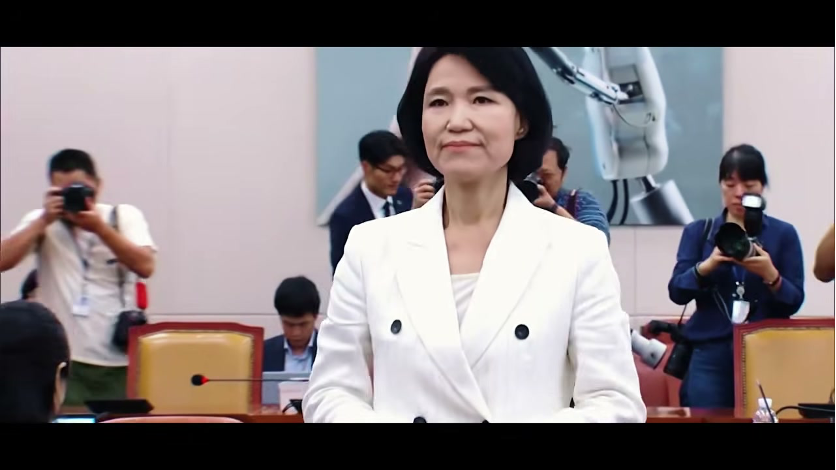
Lee Jin-suk at her Broadcasting and Communications Commission confirmation hearing. She was impeached after one day in office. When the Constitutional Court dismissed the impeachment, the Democratic Party passed legislation abolishing the commission and replacing it with a new agency. She was subsequently arrested.
The Broadcasting Commission case illustrates the escalation pattern: 1. Chair Lee Dong-gwan: appointed, resigned under impeachment pressure after 95 days. 2. Chair Kim Hong-il: appointed, impeachment filed immediately, resigned. 3. Chair Lee Jin-suk: appointed, impeached after one day. Constitutional Court dismissed the impeachment. The Democratic Party then passed legislation abolishing the entire commission, created a functionally identical replacement agency, and arrested Lee Jin-suk. Separately, the Democratic Party unilaterally cut the government budget by 4.1 trillion won — including elimination of the presidential office's special activity funds and reductions to youth and vulnerable population support programs. After Lee Jae-myung assumed the presidency, the same budget lines were restored.

JTBC report: Political broker Myung Tae-kyun threatened to release recordings and materials if arrested. The timing — days before December 3 — contributed to the pressure timeline preceding the martial law declaration.
The Democratic Party's Advance Knowledge
The documentary presents evidence that the Democratic Party had advance knowledge of martial law preparations months before December 3. According to testimony cited in the documentary, Lee Jae-myung directed lawmaker Park Seon-won to investigate military preparations for an emergency declaration. Park's office — which included staff with NIS and Ministry of National Defense backgrounds — conducted intelligence gathering through personal networks over a period of months.
"The party leader asked: "What could the Yoon administration do next?" I said: "In my assessment, it's martial law." He told me: "Investigate inside the military." So my staff — one from NIS, one from the Defense Ministry — went out drinking with their contacts every night until 1 or 2 a.m. Little by little, the information came out." — Account of Rep. Park Seon-won's activities, as reported in the documentary
When the martial law declaration came, Democratic Party lawmakers moved with coordination that the documentary characterizes as pre-planned: a Telegram channel under the code name "Wol-loom" had been pre-established, communication protocols for a potential signal blackout were in place, and military veteran lawmaker Kim Byung-joo served as operational coordinator.
Kim Min-seok — now Prime Minister — had been publicly discussing the possibility of martial law since August 2024, four months before the declaration. The Democratic Party introduced the Martial Law Prevention Act in September 2024, which would have required prior National Assembly approval for any martial law declaration. The documentary frames this legislation as a strategic forcing mechanism: President Yoon would need to act before it passed or lose the option entirely.
— — —
IMPLICATIONS FOR THE U.S. ALLIANCE
South Korea is the cornerstone of the U.S. alliance structure in the Indo-Pacific. It hosts 28,500 American service members, manufactures the majority of the world's advanced semiconductors, and serves as the primary intelligence platform for monitoring North Korean and Chinese military activity.
The evidence compiled in this documentary raises questions in four areas that are directly relevant to U.S. strategic interests:
1. Election Infrastructure Security: The NIS audit confirmed that the NEC's systems were vulnerable to external hacking, including during early voting periods when networks were connected to the internet. An internal whistleblower testified that security monitoring was inactive during elections. These findings have not been addressed. 2. Judicial Independence During Impeachment: The Constitutional Court declined to call defense witnesses, removed the primary charge from the trial, and relied on testimony that shifted on key facts. The evidentiary basis for the impeachment — a memo whose provenance is disputed and a witness whose testimony was internally contradictory — has not been subjected to independent review. 3. Legislative Overreach: The use of serial impeachments to remove executive branch officials, the unilateral slashing of the government budget, and the abolition of a constitutional body through legislation to remove a single individual represent an exercise of legislative power that, regardless of legality, raises questions about institutional balance. 4. Foreign Interference Vectors: The NEC whistleblower's testimony that unmonitored election networks were accessible from external networks — combined with the NIS's confirmed finding that server networks were not properly separated — identifies a potential vector for foreign interference in the elections of a key U.S. ally.
A straightforward verification mechanism exists:
This process would confirm or eliminate the statistical concerns identified in this report. To date, no such verification has been permitted.
— — —
This report is based on evidence presented in the documentary "[Official] 2024.12.3 That Day, The Manipulated Insurrection — Hidden Truth" by Jeon Han-gil News, supplemented by publicly available National Assembly testimony, NIS audit reports, and court records. All visual evidence is sourced from the publicly available documentary.
https://www.youtube.com/watch?v=UZFY-FLS4zQ