In August 2026, sales at Chinese shops rose only 0.4 percent from a year earlier. Car sales fell 18.5 percent. The world’s second-largest economy has stopped shopping.
Some people still call this proof that communism works. That is the wrong lesson. China left poverty because it loosened communism and allowed private business and private property. What is hurting the economy now is the planning and monopoly the Party still refuses to let go.
Mao’s Experiment Ended in Famine
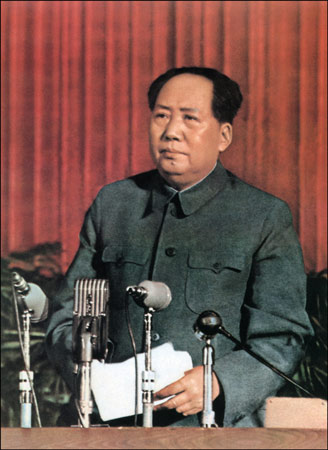
After 1949, China took land into collective hands and put factories and farms under a planned economy. The peak was the Great Leap Forward in 1958. Villages were forced into people’s communes. Families were told to make steel in backyard furnaces. The top set the numbers. The bottom reported that the targets had been met.
The result was one of the largest man-made famines in history. Grain went to the cities and to exports. The countryside starved. Estimates of the dead range from 15 million to 45 million. The figure most often used is about 30 million.
The Cultural Revolution, from 1966 to 1976, wrecked society as well. Schools shut down. Skilled people were attacked as the wrong class. Power struggles became daily life. Deaths are estimated in the hundreds of thousands to the millions. Factories stopped. Talent was lost.
The reason is simple. Without prices, without the right to own things, and without competition, no one can tell what to make or how much. False reports and force fill the numbers. People starve. Factories sit idle.
Deng Changed the Economy, Not the Politics
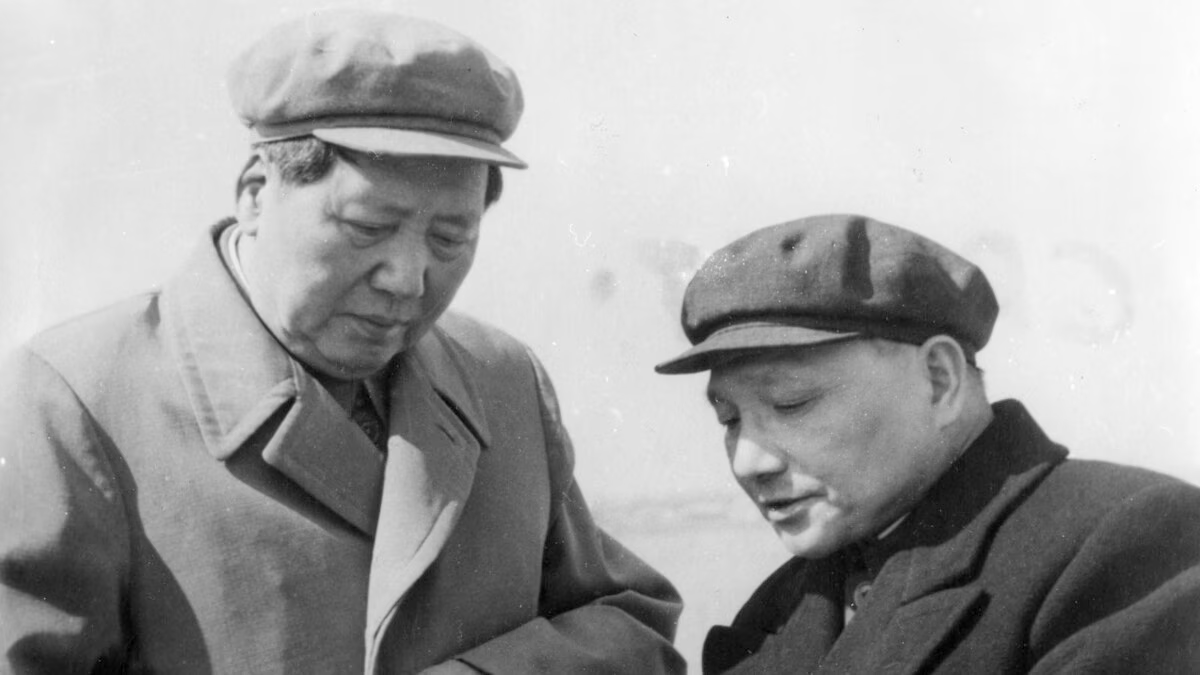
After Mao died, Deng Xiaoping changed course in 1978.
“It does not matter whether the cat is black or white, so long as it catches mice.”
What mattered, he said, was better lives, not the label on the policy. Farm families were given control of their plots. Small village firms grew. Foreign money and foreign companies came in. Private business was allowed. Some prices were left to the market. In 1992 the Party began calling this a “socialist market economy.”
Look at what actually drove growth. Poverty fell and China became an export power because of family farms, not collective farms; private firms and foreign firms, not state monopolies; prices, not ration tickets. When people could own their homes, household savings rose. Competition along the coast raised productivity. Private property, profit, and foreign capital, the very things the textbook banned, were what moved China.
Deng did not give up the Party’s grip on politics. Business moved closer to the market. Power stayed with the Party. That mix produced fast growth at first. But the Party and the officials who issue permits became both the referee and a player. Graft and vested interests spread. A real market needs more than prices. It needs rules that protect property and limits on power. In a country with no freedom of faith, no free speech, and no elections, the market cannot be free by itself. Those limits on power never arrived.
China’s Communism Is Only a Sign on the Door
The sign says communism. The inside is not communism.
It is not ordinary capitalism either, where anyone can do business freely. There are prices, companies, and profits. But the last word belongs to the Party, not the market. State firms hold the key industries. Private firms compete only as far as they are allowed. Party cells sit inside large companies and decide personnel and direction. When a private firm grows too big, it is cut down in the name of “common prosperity.” Jack Ma, the founder of Alibaba, being pushed off the public stage is the example.
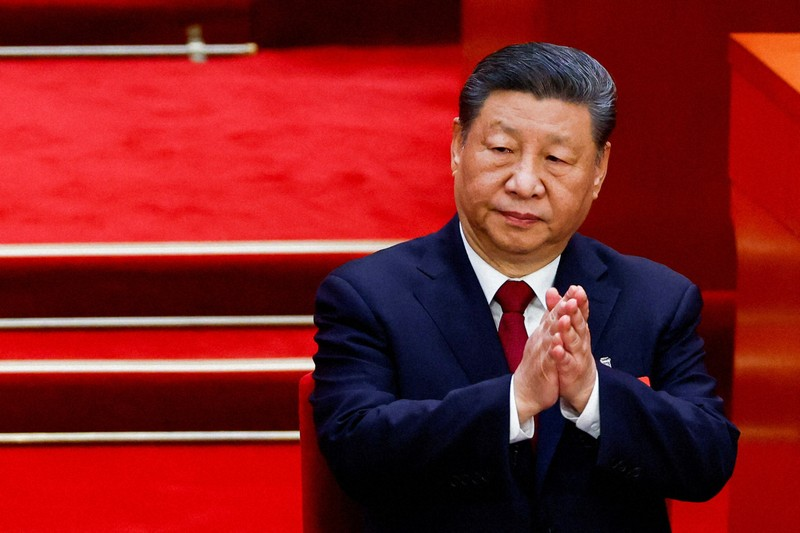
Under Xi Jinping the Party tightened its hold again. Even private tech firms are treated as if they have grown too far. In one line, this is state capitalism in which the Party is both player and referee.
The Party’s story is this: China is still in the “primary stage” of socialism, the market is only a tool, and planning is stronger in a crisis. But state firms can lose money and still be rescued. Money and land go cheap to the state sector. Private firms pay more. When the economy weakens, the state advances and the private sector retreats.
Among big property developers, the private share has fallen and state firms have grown. What the crisis protects is not the household. It is the Party and the state firms.
So the boom was not proof that communism worked. What worked was the period when communism was partly switched off. The distortions are worst where the Party still holds tight: land, local government budgets, giant state firms, and controls on money.
After the Housing Crash, Households Stopped Spending
The property crisis that began in 2021 is where those distortions meet. Local governments sold land for cash. Developers borrowed to build. Families bought homes on the assumption that prices would keep rising. When that assumption broke, construction stopped, home values fell, and people cut spending. Factories are held up by exports and high-end goods. Ordinary wallets are not moving.
Official figures from the National Bureau of Statistics and related releases now look like this:
August 2026 retail sales: up 0.4 percent from a year earlier (July: 0.6 percent; forecast: about 0.8 percent)
Car sales: down 18.5 percent from a year earlier
Fixed-asset investment, January to August 2026: down 7.2 percent. Property development investment: down 19.9 percent
Jobless rate, ages 16 to 24, excluding students: still in the mid-teens. March 2026: 16.9 percent
Overall urban jobless rate: around 5 percent
Growth: about 5 percent in 2025. 2026 target: 4.5 to 5 percent. April-June quarter: 4.3 percent, below the bottom of the range
Record numbers of graduates are entering the job market, while construction and ordinary services shrink and private firms hold back on hiring. The safety net is thin. The household registration system splits cities from the countryside. A system that preaches equality locks in unequal chances.
The population has begun to shrink. The one-child policy left too few workers and a heavier pension burden. Even the number of people was a planning error.
The Failure Is in the System, Not the Method
China was the most “successful” place to try socialism. It had a huge population, a huge market, and a Party that could learn. Even so, full collective ownership and central planning produced famine. Growth began after the market was let in. Growth slowed when the Party tightened its grip on the market again. If success is taken away and failure is bailed out, connections and politics pay better than new ideas.
The Party is not chosen by voters. Protecting the system and tax revenue come before people’s lives. This is not a special failure. It is a failure of the system itself.
What China needs is not a new slogan. It needs to protect property, put private firms on the same footing as state firms, and let failed companies leave through the market, not through politics. Until that happens, China will keep showing the world the limits of a state-run economy that still wears a communist sign on the door.
Sources
August 2026 activity (retail, cars, investment)
National Bureau of Statistics of China — “National Economy Remained Steady with Innovation-Led and High-Quality Development in August”https://www.stats.gov.cn/english/PressRelease/202609/t20260915_1965305.html
National Bureau of Statistics of China — “Basic Information on National Fixed-Asset Investment, January–August 2026”https://www.stats.gov.cn/sj/zxfb/202609/t20260915_1965309.html
Reuters — “Tech boom powers China's factories but economic imbalances deepen as consumption slows”https://www.reuters.com/world/china/chinas-factories-rev-up-slower-consumption-highlights-deepening-economic-2026-09-15/
CNBC — “China's August retail sales miss forecast as investment slump deepens”https://www.cnbc.com/2026/09/15/china-august-retail-sales-industrial-output-investment-exports-.html
Caixin Global — “China’s August Retail Sales Barely Grow as Auto Slump Deepens”https://www.caixinglobal.com/2026-09-15/chinas-august-retail-sales-barely-grow-as-auto-slump-deepens-102485121.html
Caixin Global — “China’s Investment Slump Deepens as Property Drag Overshadows Tech Shift”https://www.caixinglobal.com/2026-09-15/chinas-investment-slump-deepens-as-property-drag-overshadows-tech-shift-102485128.html
The Straits Times — “China’s industrial output rises but consumption slows”https://www.straitstimes.com/asia/east-asia/chinas-factories-rev-up-but-slower-consumption-fuels-concerns
Growth, targets, and demand
english.www.gov.cn / Xinhua — “China posts resilient H1 growth as 15th Five-Year Plan gets underway”https://english.www.gov.cn/archive/statistics/202607/16/content_WS6a58839ac6d00ca5f9a0c3db.html
Reuters — “China's Q2 economic growth cools to 3-1/2-year low as imbalances worsen”https://www.reuters.com/world/china/chinas-q2-gdp-growth-slows-43-yy-misses-market-forecast-2026-07-15/
South China Morning Post — “China’s second-quarter GDP growth misses mark, with lowest reading since end of 2022”https://www.scmp.com/economy/economic-indicators/article/3360592/china-reports-43-gdp-growth-second-quarter-falling-short-expectations
The New York Times — “China’s Economy Grows at Slowest Pace in Years”https://www.nytimes.com/2026/07/15/business/china-economy-gdp-growth.html
KPMG China — “Key Points of the Two Sessions in 2026: An Interpretation”https://assets.kpmg.com/content/dam/kpmgsites/cn/pdf/en/2026/03/key-points-of-the-two-sessions-in-2026-an-interpretation.pdf.coredownload.inline.pdf
Merics — “Beijing is failing to meet the challenge of weak domestic demand”https://merics.org/en/tracker/beijing-failing-meet-challenge-weak-domestic-demand
Merics — “Domestic obstacles, global opportunities: The road to implementing China’s 15th Five-Year Plan”https://merics.org/de/studie/domestic-obstacles-global-opportunities
ING Think — “China’s weak domestic demand continues to undermine growth”https://think.ing.com/articles/disappointing-domestic-demand-continues-to-drag-chinas-growth/
National Bureau of Statistics of China — “Total Retail Sales of Consumer Goods from January to July 2026”https://www.stats.gov.cn/english/PressRelease/202608/t20260819_1965078.html
Youth unemployment
Reuters — “China's youth jobless rate rises to 16.9% in March”https://www.reuters.com/world/asia-pacific/chinas-youth-jobless-rate-rises-169-march-2026-04-21/
Reuters — “China's February youth jobless rate dips to 16.1%”https://www.reuters.com/world/asia-pacific/chinas-february-youth-jobless-rate-dips-161-2026-03-19/
Caixin Global — “China’s Youth Unemployment Rises After Six-Month Decline”https://www.caixinglobal.com/2026-04-21/chinas-youth-unemployment-rises-after-six-month-decline-102436430.html
Caixin Global — “China Youth Jobless Rate Falls to 16.1%, Extending Decline”https://www.caixinglobal.com/2026-03-19/china-youth-jobless-rate-falls-to-161-extending-decline-102424813.html
Young Post / SCMP — “Unemployment for China’s young people worsens as record graduation season looms”https://www.youngpostclub.com/yp/news/china/article/3350884/unemployment-chinas-young-people-worsens-record-graduation-season-looms
BMJ / PMC (Vaclav Smil) — “China's great famine: 40 years later”https://pmc.ncbi.nlm.nih.gov/articles/PMC1127087/
The New York Times — “China’s Cultural Revolution, Explained”https://www.nytimes.com/2016/05/15/world/asia/china-cultural-revolution-explainer.html
CFR Education — “How China Transformed Under Mao Zedong and Deng Xiaoping”https://www.cfr.org/education/learn/reading/china-mao-zedong-deng-xiaoping
Marxists Internet Archive — Deng Xiaoping, “Building a Socialism With a Specifically Chinese Character” (1984)https://www.marxists.org/reference/archive/deng-xiaoping/1984/36.htm
Marxists Internet Archive — Deng Xiaoping, “We Can Develop A Market Economy Under Socialism” (1979)https://www.marxists.org/reference/archive/deng-xiaoping/1979/152.htm
Cato Institute — “China’s Post-1978 Economic Development and Entry into the Global Trading System”https://www.cato.org/publications/chinas-post-1978-economic-development-entry-global-trading-system
State vs private sector, and the Jack Ma case
RIETI — “Private Enterprises in Distressed China”https://www.rieti.go.jp/users/china-tr/jp/ssqs/230911ssqs.html
RIETI — “Institutional Factors in China’s Economic Development”https://www.rieti.go.jp/users/china-tr/jp/ssqs/241209ssqs.html
RIETI — “Light and Shadow of Authoritarianism in China”https://www.rieti.go.jp/users/china-tr/jp/100730kaikaku.html
Nippon.com — “China’s Struggling Economy: The ‘Sovietization Trap’ Facing Xi”https://www.nippon.com/ja/in-depth/a09604/
Nippon.com — “The Chinese Communist Party at 100: Market Policy as the Problem”https://www.nippon.com/ja/japan-topics/c05808/
Keio / Mita Hyoron — “Kokubun Ryosei: The CCP at 100”https://www.keio.ac.jp/ja/about/public-relations/mita-hyoron/features/08-2-4/
Al Jazeera — “China’s year of crackdowns: Party first, business second”https://www.aljazeera.com/economy/2021/12/27/chinas-year-of-crackdowns-party-first-business-second
Bloomberg — “China’s Tech Crackdown a Year Later: How Business Changed Forever”https://www.bloomberg.com/graphics/2021-china-tech-crackdown-one-year/
The Guardian — “‘Jack Ma is tamed’: How Beijing showed tech entrepreneur who is boss”https://www.theguardian.com/business/2020/nov/04/jack-ma-ant-group-is-tamed-social-media-reacts-after-china-blocks-ipo
East Asia Forum — “Tech crackdowns rid China of entrepreneurial capitalism”https://eastasiaforum.org/?p=2133009
The New York Times — “The End of a ‘Gilded Age’: China Is Bringing Business to Heel”https://www.nytimes.com/2021/10/05/business/china-businesses.html