

Japan's Supreme Court, which is meant to be the final protector of the constitution, confirmed the dissolution of a religious group without ever discussing that constitution. It is the first case in Japan where a religious corporation was dissolved not over a criminal offense, but over a civil-law dispute alone.
The group is the Family Federation for World Peace and Unification (the Unification Church). Former chairman Tanaka Tomihiro and Imamura, a former Legal Affairs Bureau official, went through the ruling on the YouTube program "No Filter."
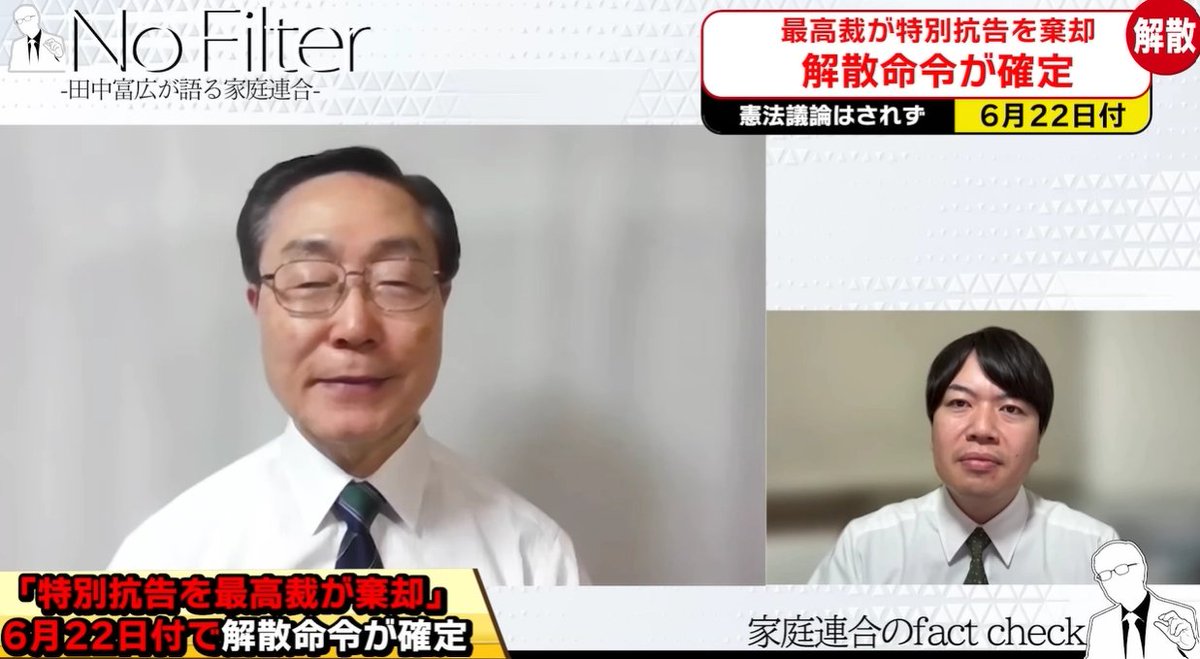
On June 22, 2026, Japan's Supreme Court rejected the appeal of the Family Federation and confirmed the order to dissolve it. Japan's Ministry of Education filed for the dissolution in October 2023. After that, the district court and the high court both upheld it, and after more than two and a half years, the Supreme Court reached its conclusion.
An Overview of the Supreme Court Decision
The decision held two surprises.
The first is that the Supreme Court, which is supposed to handle the constitution, avoided discussing the constitution. The second is that even a "settlement," which is meant to bring a dispute to a peaceful close, was treated as evidence of wrongdoing.
On top of that, the decision was very short: the actual ruling was a single line, and the whole document was only four pages. Former chairman Tanaka Tomihiro says, "It was so short that I could guess what was inside before I even read it."
Although this kind of case is normally handled by five judges, the name of one judge, Okino Masami, was missing from the decision. She was the judge the Family Federation had asked to have removed, because of critical remarks she had made in the past. Tanaka suspects that "the inconvenient part was quietly taken out."
Avoiding the Constitutional Debate
Japan's Supreme Court is called "the guardian of the constitution," the court that makes the final check on whether a law or a ruling breaks the constitution. The "special appeal" the group used is also a procedure that is allowed only when the reason is a violation of the constitution. So the group knocked on that last door, saying, "This dissolution order breaks the constitution." Several constitutional scholars and lawyers had submitted written opinions pointing out constitutional violations.
But the decision did not answer those constitutional questions head-on.
For example, the group had argued, "Deciding to dissolve us without ever holding an oral hearing (a session to hear each side's case) violates our right to a trial." This too is a constitutional argument. In response, the decision treated the dissolution order not as a normal trial where the two sides argue in court, but as a "non-contentious case" that the court handles as routine business, and brushed it aside, saying "so no oral hearing is needed" and "this is an administrative action."

Then, at the end of the decision, the other constitutional arguments the group had laid out were all dismissed together as "in substance, merely claims of a violation of ordinary law." This means, "That is not a constitutional issue, just a matter of ordinary law," and once it is treated that way, a special appeal can no longer get through.
Tanaka spoke with clear surprise.
"That is exactly why we filed a special appeal on the grounds of a constitutional violation, but they rejected all of it. They put a lid on the constitutional debate completely. If that is so, what is the point of having a Supreme Court at all?"
The Grounds for the Ruling
The reason for the dissolution is Article 81(1)(i) of Japan's Religious Corporations Act.

What matters is that this "violation of law" was found to include not only criminal acts but also a "wrongful act" under civil law, an act that breaks the law and harms people. The group has not had a single criminal case. It was dissolved over a civil-law dispute alone.
The district court found that, from 1973 to 2022, believers had kept asking for donations in ways that amounted to wrongful acts and had harmed many people, and the Supreme Court took this as it stood. But Imamura questions that end date, "until 2022." The last civil case fought in court was around 2014. If you ask which act, and when, counted as a violation after that, almost no one can answer.
Even so, the ruling said the violations continued until 2022. What is more, even cases that had been closed by "settlement" in the past may have been counted as evidence of a violation. A settlement, which is supposed to be an agreement to end a dispute peacefully, was turned into "evidence of having done something wrong."
The group also had a way to challenge the fact-finding itself. On the same day as the special appeal, it had filed another objection called a "permitted appeal," which can point out not only constitutional problems but also faulty fact-finding and violations of law. But this objection was decided not by the Supreme Court, but by the high court itself, the very court that had made those findings, and it was thrown out the same day, on March 31.
The door to question the constitution was closed at the Supreme Court, and the door to question the fact-finding was closed at the high court. For the group, both doors to fight were shut.
What happens to believers' "freedom of faith"?
The decision said that the impact on both freedom of religious activity and freedom of association would be "only an indirect, practical effect."

Even if the group loses its buildings, faith itself is not banned; even if it is no longer a religious corporation, it can keep going as an ordinary group, so the impact is "indirect." That is the reasoning. But Tanaka pushes back: there is no way that losing places of worship and the centers of their activity is "indirect" for believers.
The decision itself also admits, at one point, how serious the problem is.

Once the dissolution is final, places of worship and other property will be sold off, and this could get in the way of believers' religious life. So the decision says it "must carefully examine whether the constitution allows going this far."
Yet the Supreme Court did not carry out that examination itself. If it is truly a problem, then Parliament has no choice but to rewrite the law. And the court left that big homework behind and stepped away from it.
Concerns for the Future
What this decision leaves behind is not just the fate of the Family Federation.
Tanaka points out that religion has a weakness it cannot avoid. While faith burns strong, things are fine, but once it cools, some people later come to feel they were "deceived" and sue the group. This is not unusual in the world of religion. In other words, no religious group can be completely free of civil disputes.
On top of this, the new decision weighs heavily. As noted earlier, even the fact of a settlement was treated as evidence of a violation. Now that the peaceful way out has been shut, religious groups will come to feel it is safer to avoid settlements and fight every dispute to the end in court.
From now on, the dissolution of a religious corporation may also move forward through a closed, non-public process. Together with a new law passed in recent years that limits aggressive fundraising for donations, the organizations and places that support faith will walk a narrower road than before.

Believers could not even argue their case fully in court. And the conclusion that finally came was a thin one of only four pages, and it felt careless. The Japanese media, which kept reporting on the whole uproar for a long time, also turned its attention away once the trial closed, and there is hardly any reporting that digs into what such a decision actually says. The worry remains that, among people who see only this decision, prejudice against people of faith will spread even further.
The conflict surrounding the Family Federation has continued for many decades. Without knowing that long background and what each believer is really like, one cannot speak about this group. Even if a dissolution order is handed down, it is a procedure that removes legal status, and it is not a reason to brand believers as a criminal group, as antisocial, or as a cult.