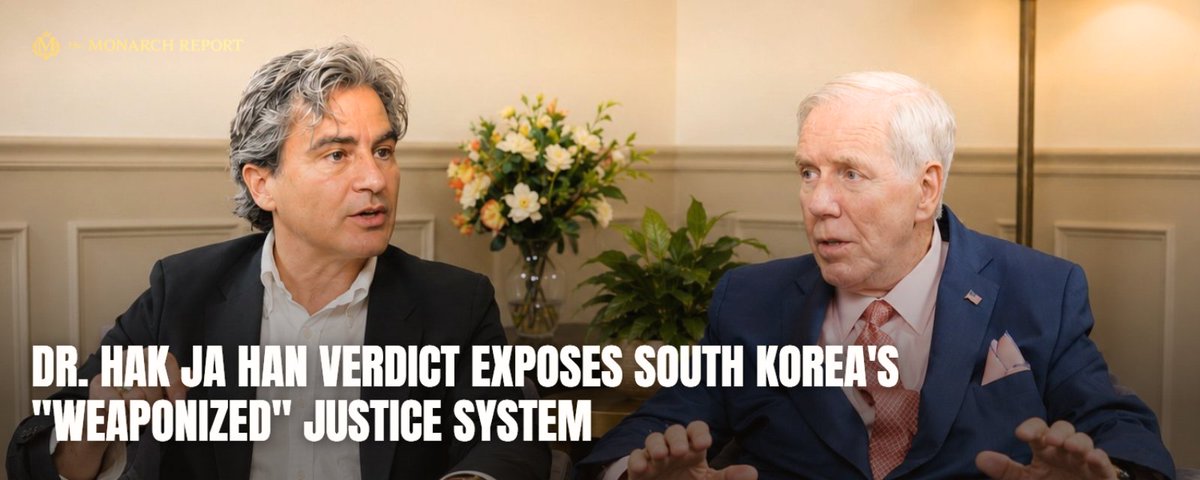
Randy Evans, former U.S. Ambassador to Luxembourg, told Family Federation USA president Damian Dunkley that South Korea's prosecution of the church's leader follows a pattern of politically driven enforcement that has already reached American citizens.

The Verdict
A Seoul court sentenced Dr. Hak Ja Han, the 83-year-old leader of the Family Federation for World Peace and Unification, to two years in prison on August 31 over political funding and bribery allegations tied to influence-seeking with the administration of former President Yoon Suk Yeol. Prosecutors had sought 13 years.

Days before the ruling, Evans, now a visiting professor of law at Ave Maria School of Law in Naples, Florida, recorded an extended interview with Dunkley arguing that the case rested on association rather than evidence.
"Since President Lee took office in South Korea, we have seen a steady weaponization of the government to attack what he perceives to be political enemies."
It Started Before the Family Federation
Evans argued the sequence matters. The first target, he said, was a conservative Protestant pastor, Son Hyun-bo, prosecuted under South Korea's election law for remarks delivered in a sermon and later released with a suspended sentence.
Once that succeeded, Evans said, the approach spread: anyone affiliated with a church who opposed the government could be accused, indicted, convicted, and imprisoned. He described it as an effort to divide faith communities and remove them one at a time.
The Raids

Authorities conducted repeated search-and-seizure operations against the church, its institutions, and Dr. Hak Ja Han's residence, including a July 2025 operation involving more than 1,000 officers. Evans said he was in Korea during one raid.
Asked by Dunkley whether U.S. judges would approve warrants to search the same premises two or three times, Evans said no, citing First Amendment protections.
"Long ago the prosecutions here crossed a very clear boundary. But that's when it became so obvious what was happening."
Guilt by Association

A former chief of staff received eight months, suspended for two years. Dr. Hak Ja Han faced a demand of 13 years. Dunkley asked why the spiritual leader would draw the heavier penalty when prosecutors had not shown direct involvement.
"Guilty by association. They haven't been able to prove she had anything to do with any of this stuff directly. Why would the leader of a global movement get more time than the pastor of a local church? If the person making that decision is worried about relative political power, is that not enough proof itself?"
Evans put the underlying charge in plainer terms, saying the church backed a candidate who lost and was being accused of picking the wrong horse in the last race.
He also rejected the principle of holding a faith leader responsible for the conduct of members, noting that Christ had Judas but was not crucified for Judas's sins. Pressed on what the prosecution was ultimately about, Evans said the charges would disappear if Dr. Hak Ja Han withdrew from public life and endorsed the government.
"They'd leave her alone tomorrow if she just quit. This isn't about what she's done. This is about who she is."
Where Power Comes From

Evans framed the dispute as a disagreement about the origin of rights, contrasting a system in which liberties come from God and cannot be removed with one in which the state is the source of authority.
"What he's done is to weaponize the government in a way to say: the state has the power to prevent you from worshiping in the way you want to worship."
He pointed to Japan as evidence that advanced democracies are not exempt. Courts there ordered the dissolution of the Unification Church, and Evans described the consequences in concrete terms: churches padlocked, hymnals seized, cemeteries taken.
"Imagine any of us having the remains of our fathers and our mothers and our sisters and our ancestors seized by the government and put up for public sale."

He said the objection he most often hears is that such things happen only in countries without established legal protections. His answer was that Japan and South Korea are advanced democracies and treaty allies of the United States.
An American Ambassador Indicted
Dunkley raised the risk of speaking publicly at all, noting he was not supposed to be discussing the subject. Evans agreed the risks were serious, citing Morse Tan, a former U.S. ambassador-at-large who had his passport withheld and was indicted in South Korea on defamation charges.

"If they're willing to take the passport and arrest and indict a former United States ambassador, I don't want to diminish the threat."
Members of Congress have written to South Korea's ambassador in Washington raising concerns about freedom of expression and due process in Tan's case.
Isolation and Faith
Dr. Hak Ja Han has been transferred repeatedly between a detention center and hospital for treatment of a heart condition, injuries from a fall, and glaucoma.
Evans said confinement serves a purpose beyond punishment: separating a leader from her family, friends, and fellow believers in the belief that isolation will break her faith.
"Locking an 83-year-old grandmother in a detention facility that results in her being repeatedly hospitalized is cruel. But they're not going to win. They nailed Christ to a cross and they lost."
Asked what members should do if the sentence proved harsh, Evans offered three things: pray, stay publicly engaged, and reject apathy, which he called the condition that allows churches to be dissolved.
On the prospect of dissolution proceedings against the Family Federation itself, he was direct.
"I defy any power on planet Earth to dissolve or eliminate the church. It's not going to happen."
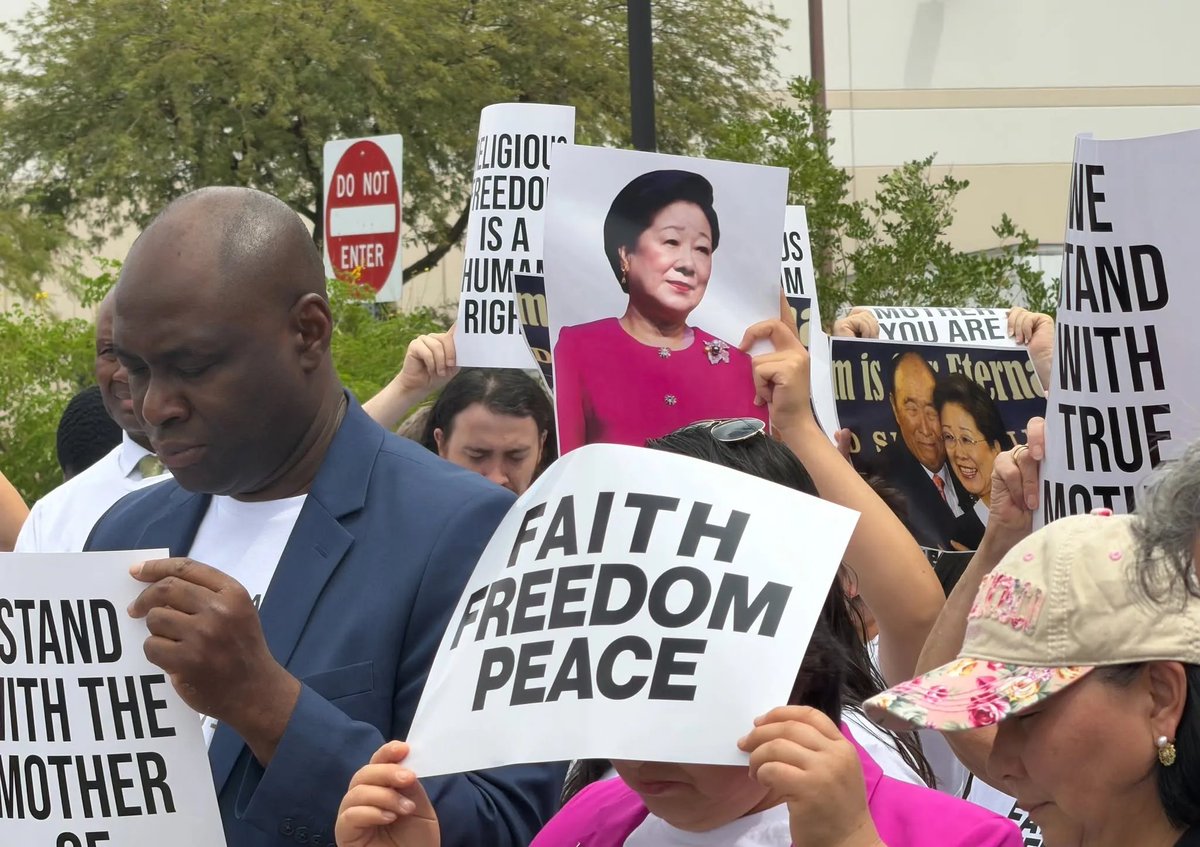
Dunkley closed by inviting members to a prayer gathering in Las Vegas on August 30, timed to the August 31 first-instance verdict against Dr. Han in Seoul.

The venue is the International Peace Education Center, a facility he said was purchased and built by Rev. Sun Myung Moon and Dr. Hak Ja Han for the purpose of gathering to pray for world peace.
Dunkley said participants would move outside the building to pray under the open sky, and framed the gathering as directed not only at her case but at religious freedom broadly. It marked the closing day of a period of daily prayer and fasting that members had observed worldwide in the weeks leading up to the verdict.