
Trump's 25% Tariff Is Destroying Korean Workers While Lee's China Pivot Leads Nowhere
While American media focuses on higher car prices, Korean factory workers are watching their livelihoods disappear. Trump's 25% tariff on Korean imports isn't just raising costs for US consumers.
It's triggering an economic crisis that threatens to push South Korea into recession, and President Lee Jae-myung's desperate pivot toward China won't save them.
The numbers tell a brutal story. Hyundai and Kia lost 4.64 trillion won ($3.3B USD) in the second and third quarters of 2025 alone. Operating profits dropped 20.1% year over year. Workers at assembly plants in Ulsan are openly worried about overtime cuts, which make up a significant portion of their wages.
At GM Korea, which exports 90% of its production to the United States, union members voted 88.2% to strike over job security fears. Analysts warn that 25% tariffs could force plant closures, threatening 6,851 jobs directly and thousands more in the supplier network.
This isn't theoretical pain. Korea's GDP growth has slowed to 0.8% to 1.0% in 2025, near recession territory. The economy actually contracted 0.2% in the first quarter. Without a trade deal, economists project a 0.4% decline. The won has depreciated 10% in six months, making imports more expensive and fueling inflation that hits ordinary Koreans buying food and fuel.

The Competitive Massacre
The tariff structure reveals Trump's strategy. Japan gets 15% tariffs. Korea gets 25%. That 10 percentage point gap means Toyota and Honda can now undercut Hyundai and Kia on price in the American market. Korean automakers lose market share overnight to Japanese competitors who face lower barriers to entry.
For context, vehicles and auto parts make up one third of Korean exports to the United States. The US market represents 18% of all Korean exports. When your second largest market suddenly imposes a 25% tax on your most important export category, and your main competitor gets preferential treatment, the math is simple. You lose.
The pharmaceutical sector faces similar pressure. South Korea exports nearly $1 billion in pharmaceuticals to the US annually. Generic drug makers like Celltrion and Hanmi are getting squeezed on price. Medical device manufacturers are absorbing tariff costs. Construction materials, electronics from Samsung and LG, semiconductors - all hit with the same 25% penalty at the US border.

Why Lee Can't Accept Trump's Deal
Trump has offered Korea a way out: invest $350 billion in US projects and the tariffs disappear. Lee Jae-myung can't take the deal, and the reason is simple math that threatens Korea's financial stability.
South Korea's total foreign currency reserves stand at $415 billion. The Trump deal would consume $350 billion, or 84% of the entire reserve. If paid in cash as Trump demands, it would trigger a liquidity crisis that Lee publicly warned could recreate the 1997 Asian Financial Crisis, when South Korea's currency collapsed and required an IMF bailout.
Lee proposed safeguards: a currency swap line with the US Federal Reserve to access emergency dollars, staggered payments tied to market conditions, and commercially viable investments rather than cash transfers at Trump's discretion. Trump wants more upfront cash and control over where investments go. The framework was agreed in July and reaffirmed in October, but crucial details remain unresolved.
Even though Lee's Democratic Party controls the National Assembly with 167 of 298 seats, they won't pass legislation that commits such massive reserves without protections. The political establishment remembers 1997. The deal's structure creates an impossible choice: accept economic suicide to avoid tariffs, or reject the deal and face tariffs that destroy Korean exports.
The China Illusion
Watching his economy slide toward crisis, Lee Jae-myung has turned to Beijing. Xi Jinping visited South Korea in November 2025 for the first time in 11 years. In January 2026, Lee made a state visit to China as the first foreign head of state to visit in the new year.
They've met twice in two months. Lee brought Samsung's Lee Jae-yong, Hyundai's Chung Euisun, and LG's Koo Kwang-mo, Korea's entire business elite.
The symbolism is deliberate. Lee declared Korea should "seek coexistence and cooperation with Beijing to the greatest extent possible" and work to "minimize or eliminate past misunderstandings or contradictions."
They signed 14 memorandums of understanding on trade, technology, and AI cooperation. Bilateral trade reached $306 billion in 2025, up 1.6%.
But the meetings are theater. China is becoming Korea's competitor, not its customer, and the numbers prove it.
In 2013, Korea had a $62.8 billion trade surplus with China at its peak.
In 2023, Korea posted its first trade deficit with China in 30 years, losing $18 billion. China no longer needs Korean products because they make them themselves now.
The structural relationship has fundamentally changed. In the 1990s and 2000s, Korea exported high tech components and China assembled them. Now China makes the components and the final products. Korea's role is disappearing.

The THAAD Lesson
Lee knows what happens when Korea gets too close to the United States militarily.
In 2016, when Korea deployed the US THAAD missile defense system, China retaliated by banning Chinese tour groups to Korea, blocking K-pop and Korean dramas, boycotting Korean products, and harassing Korean companies with regulatory pressure.
The message was clear: get closer to the US militarily and China will punish you economically. Lee can smile at Xi and sign memorandums, but he can't actually choose China over the United States without destroying Korea's security and economic foundation.
The Numbers Don't Lie
Korea's export share to China has been collapsing.
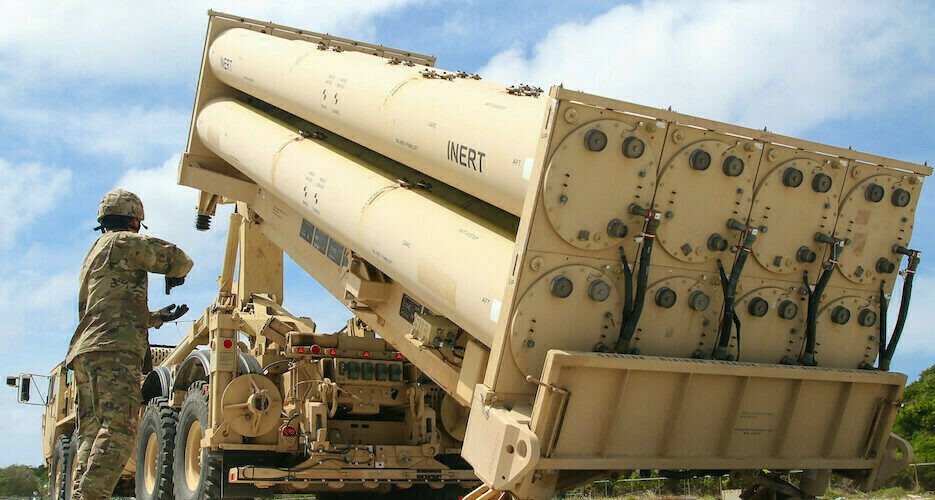
The United States is now Korea's number one export market, having overtaken China. Lee can't pivot away from the market that buys the most Korean goods. Southeast Asia can't absorb the volume. Vietnam, Thailand, the Philippines, and Indonesia combined can't replace the $220 billion that US and China markets represent.
Meanwhile, China is now competing with Korea for those same markets. A Bank of Korea report from November 2025 warned that "China's export diversification will enhance the influence of Made in China in emerging markets and difficulties of other manufacturing centered countries such as South Korea will increase."
As the US hits China with tariffs, China floods Europe, Southeast Asia, the Middle East, and Latin America with cheap exports in EVs, solar panels, batteries, and steel, undercutting Korean products globally.
The Security Reality
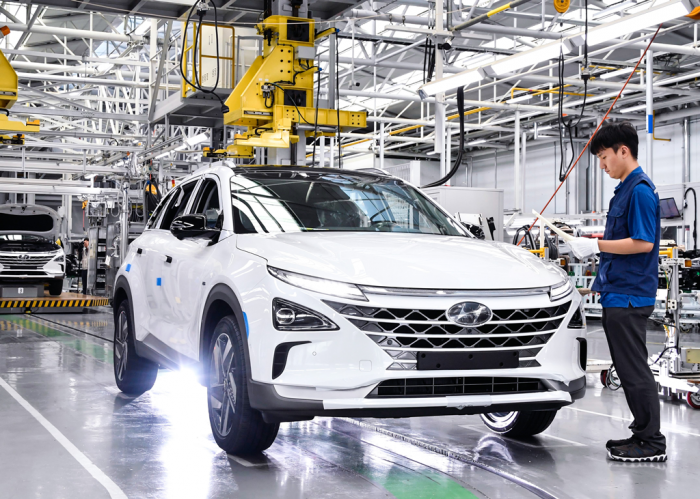
Lee can't break with the United States because 28,500 US troops defend South Korea from North Korea. The US nuclear umbrella protects Korea. Korean military equipment and technology depend on American systems.
Korean companies have invested over $20 billion in US plants. The conservative opposition would destroy Lee politically if he pivoted too far toward China. Japan, Australia, and other allies are watching.
Xi Jinping knows Korea has no leverage. China can replace Korean semiconductors with domestic or Taiwanese chips. China can source technology from Japan, Taiwan, and Vietnam. China controls rare earth minerals Korea needs. China has leverage through North Korea, able to pressure or protect Pyongyang depending on Korean behavior.
Korea needs three things:
Trump is threatening the first. China can't replace it. Getting closer to China risks alienating the US on the third.
The Workers Pay Three Times
While Lee plays diplomatic theater with Xi, Korean workers face consequences that hit them from three directions simultaneously.
The National Pension Service, which manages 1.43 quadrillion won ($1 trillion USD) in retirement savings for Korean workers, has been activated as an emergency tool to stabilize the currency.
The pension fund holds $575 billion in foreign assets as of October 2025, representing 58% of total holdings.
In December, authorities ordered the NPS to begin strategic hedging operations, selling dollars to support the won. The fund can hedge up to 10% of its foreign assets, potentially deploying over $54 billion to defend the currency. The NPS also extended its $65 billion currency swap with the Bank of Korea through the end of 2026.
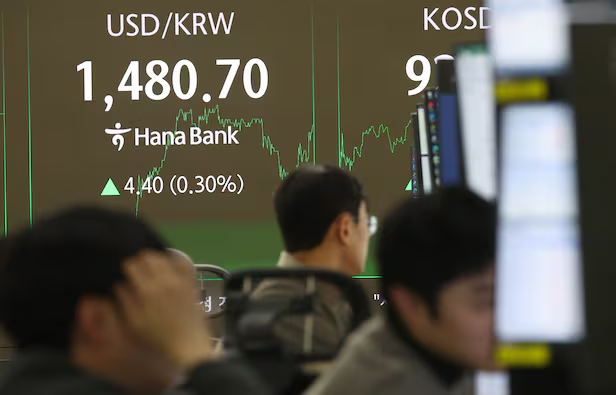
The won depreciated 8% in the second half of 2025, hitting seven to eight month lows and touching 1,470 to 1,480 per dollar multiple times.
Foreign investors pulled over $1.4 billion from Korean equities in just three days.
Government officials publicly called the weakness excessive and scrambled to shore up the currency. Just two days ago, on January 26, the NPS lowered its target for foreign stock holdings to reduce dollar demand and prop up the won.
And it's not working. The won remains weak despite these interventions.
Now Trump wants another $350 billion on top of the pension funds already being spent. That demand would consume 84% of Korea's $415 billion in foreign reserves. The workers are being squeezed from every direction, losing income today while their savings are spent and their economic future mortgaged.
The pharmaceutical sector workers watch generic drug makers struggle with price pressure. Construction workers face higher costs for imported materials. Electronics sector employees at Samsung and LG compete with Chinese rivals who face no tariffs entering third country markets. The shipbuilding industry, a major employer, operates under the shadow of Chinese sanctions and US tariff threats.
This is what happens when your entire economy depends on exports and your biggest customer decides to weaponize market access.
Korea exports 40% to 50% of GDP. The US and China together represent over one third of Korean exports. When both markets turn hostile or unstable simultaneously, there's no safety net.
Lee Jae-myung inherited an impossible situation. Trump demands $350 billion that would drain 84% of Korea's foreign reserves. Rejecting the deal means 25% tariffs that destroy competitiveness and push the economy into recession. Pivoting to China encounters the reality that China is now Korea's competitor, not its customer, and that China weaponizes trade for political compliance.
The Korean people are trapped by geography, history, and economic structure. They built an export economy that thrived when US and China markets were open and stable. Now both are closed or unstable.
The factory workers in Ulsan and Gwangju who built Hyundai and Kia into global brands are watching their jobs disappear. The pharmaceutical workers who supplied American hospitals during COVID face layoffs. The electronics workers who made Samsung a household name see Chinese competitors taking their market share.
Lee's meetings with Xi are desperation, not strategy
The memorandums of understanding won't reverse structural economic trends. China's trade deficit with Korea, the first in 30 years, proves the relationship has fundamentally changed. Korean workers know this. They see the factory floor reality that politicians try to spin away.
Trump's 25% tariff is crushing Korean workers, not because of economic theory, but because of basic math. When you make it 25% more expensive to sell your products in your biggest market, and your main competitor gets a 15% deal, you lose.
When your president can't accept the deal to remove tariffs without draining your country's financial reserves, you lose. When your only alternative is a competitor nation that no longer needs your products, you lose.
That's Korea's reality in 2026. The workers are paying the price while politicians smile for cameras and sign documents that won't save them.