

When Reporting Creates "Facts"
One day, you lose your job.
The reason: because of your religion**.**
You try to rent an apartment.
The contract falls through at the last stage.
Same reason.
This is not a story from an authoritarian state.
It is happening in Japan, right now.
A second-generation believer of Family ****Federation ****working at an advertising agency in Fukuoka had landed two contracts in just two months.
His boss was so impressed he gave him five neckties as a gift.
But at an after-work drinking party, the young man declined alcohol for religious reasons.
When his faith came to light, the company president shouted at him.
He was terminated the next day.
He won the lawsuit that followed — but a court verdict cannot erase the scars carved into a 20-year-old's heart.
Why does this happen?
One answer lies in "media framing."
How the press selects, trims, and contextualizes facts fundamentally reshapes public perception.
And that perception carries enough force to destroy the life of the person sitting right next to you.
"Cult": A Label Too Convenient

The 1995 Tokyo subway sarin attack by Aum Shinrikyō left a deep wound in Japanese society.
But it also left the media with a kind of template.
As research by Professor Erica Baffelli at the University of Manchester demonstrates, Japanese media began using the word "cult" (karuto) freely when covering any new religious movement after the attack.
The word automatically carries connotations of brainwashing, violence, and fraud.
A single incident by one group came to define the public image of hundreds of unrelated religious organizations.
The problem is that this "cult" frame remains alive nearly three decades later.
In 2025, four United Nations Special Rapporteurs jointly raised concerns about Japan.
They pointed out that "Children's Human Rights SOS Mini-Letters" distributed in schools reinforced discriminatory stereotypes against religious minorities.
Practices as varied as Jehovah's Witnesses not celebrating birthdays and the dietary laws of Judaism, Islam, and Hinduism were all placed under the vague umbrella of "child abuse related to religious beliefs."

The UN experts stated:
Rather than protecting children who belong to religion or belief minorities, these materials risk contributing to their bullying and marginalization."
Materials designed to protect children end up hurting them.
Is this irony? Or is it the inevitable result of underestimating the power of framing?
Zainichi Koreans, Another Casualty of Framing
Prejudice against religious minorities is just one facet of the discrimination embedded in Japanese society.
In July 2022, immediately after the assassination of former Prime Minister Shinzo Abe, a false claim spread like wildfire across social media: that the suspect was a "Zainichi Korean."
It was entirely untrue, but the speed of the lie far outpaced any fact-check.
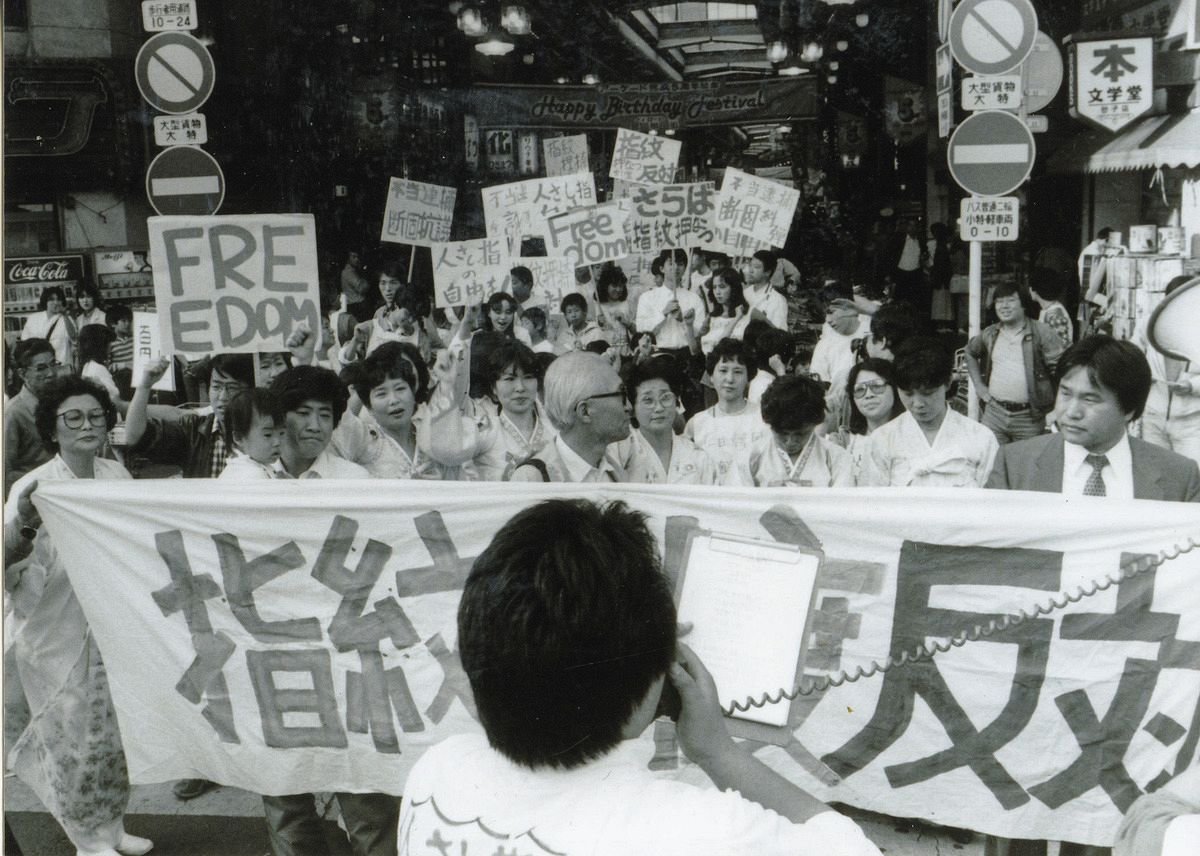
As TIME reported, Zainichi Koreans are the most targeted minority in Japan, subjected to relentless discriminatory speech online.
In 2021, a 22-year-old man set fire to and destroyed seven buildings in Utoro, an ethnic Korean neighborhood in Uji, Kyoto.
The court found that the perpetrator had been radicalized by consuming anti-Korean content online.
Or consider the case of Fuji Corporation, an Osaka-based homebuilder.
Management distributed flyers in the workplace that included screenshots of xenophobic YouTube videos. The materials featured online comments reading "Die Zainichi."
A third-generation Zainichi Korean woman employed there suffered psychological distress and filed a lawsuit.
What do these cases have in common?
Negative framing of specific groups, amplified repeatedly through media and online platforms, eventually crystallizes into real-world discrimination and violence.
The Story of "Pitiful Children"
The label attached to second-generation believers of the Family Federation (formerly the Unification Church) comes from a slightly different angle of framing.
The media portrays them as "pitiful children forced into faith by their parents."
But multiple second-generation believers who have spoken out on the streets challenge this one-dimensional depiction.
One believer stated plainly that among his four siblings, "not a single one was forced."
He remained in the church because he saw people, his family and church members, who truly "lived for the sake of others."
Another believer, Mr. Fukunaga, shared how his father, a church staff member, collapsed from a brain hemorrhage and was left with severe disabilities.
There was a time when he doubted God's existence and sank into despair, feeling "it would be fine if I disappeared."
But watching his mother accept his disabled father as "a precious person chosen by God" and devote herself to his care, he rediscovered the meaning of faith.
"My life cannot exist without this person," his mother declared. Those words became, for him, proof of what faith could mean.
But stories like these almost never make it into the media.
Why?
The reason is simple.
"Pitiful victims" get better ratings. Multifaceted reality doesn't fit into a 30-second news clip.
And what doesn't fit is treated as if it never existed.

The Irreversibility of Framing
The most dangerous property of media framing is its irreversibility.
Once a label like "cult," "dangerous," or "brainwashed" has been applied, removing it becomes nearly impossible.
No matter how much counter-evidence is presented, the cognitive framework formed in people's minds does not change easily.
What psychologists call "confirmation bias" takes over and only the information that fits the existing frame is selectively absorbed.
The U.S. State Department's 2023 Report on International Religious Freedom noted that Family Federation members were unable to openly express their faith following the Abe assassination, due to what they described as "biased" or "antagonistic" media coverage and pressure from the National Network of Lawyers Against Spiritual Sales.
Cases were documented in which members were denied participation in community cultural events and had monetary donations rejected.
Holding a religious belief, an inherently private choice, becomes directly linked to public disadvantage.
This is happening in a country where freedom of the press and freedom of religion are both constitutionally guaranteed.
Why Discrimination in Developed Nations Is Hard to See
Japan has ratified most major international human rights treaties.
Freedom of expression and freedom of religion are both enshrined in its constitution.
And yet, discrimination fueled by media framing persists.
It remains invisible because discrimination in developed nations operates not through the absence of law, but through "atmosphere."
The stated reason for a firing is never "religion."
A rental refusal is explained as "a comprehensive judgment."
Bullying at school is dismissed as "something between kids."
Everything takes an ambiguous form.
That is precisely why it is hard to denounce and even harder to make visible.
The vagueness of the concept of "public welfare" that UN Special Rapporteurs flagged strikes at the very heart of this issue.
What violates "public welfare"?
As long as that definition shifts with political and social currents, minorities will always stand on unstable ground.
Dialogue as a Prescription
The second-generation believer who gave a street speech in front of the Okinawa Prefectural Office chose to turn his wounds a starting point for dialogue rather than grounds for accusation.
When a Christian pastor asked him, "Couldn't you have had more dialogue with children who were hurt within the church?" — the words cut deep.
And that pain strengthened not his desire to criticize, but his resolve to pursue mutual understanding.
Is this beautiful idealism?
In reality, simply beginning a dialogue remains enormously difficult.
But what can ultimately counter framing is individual human voices and faces.
Not statistics or labels, but one person's experience changing another person's perception.
"Even in an era when religion tends to be disliked, I believe in a future where people will say, 'Religion really was necessary after all’”.
It would be easy to call these words optimistic.
But behind them lies a quiet conviction to continue fighting prejudice and stay true to their beliefs.
The Question Is Ours
It doesn't matter what faith the person sitting next to you holds.
It doesn't matter what ethnic background they come from.
The question is whether you are judging their life by a story the media created for you.
Japan is one of the safest countries in the world, proud of a culture that values courtesy and order.
In that same country, people lose their jobs and are denied housing because of their beliefs.
Ethnic neighborhoods are set on fire based on social media lies.
Government-distributed educational materials fuel the bullying of children from religious minorities.
These are not exceptional incidents.
They are the result of the quiet violence of “media framing” that has seeped into the fabric of everyday life.
Being a developed nation does not prove the absence of discrimination.
It may, in fact, prove that discrimination has been made invisible with greater sophistication.
There is a decisive line between reporting facts and using framing to push a specific group to the margins of society.
Guarding that line is not the responsibility of media alone.
It belongs to each of us. Whether it’s those who receive information or share it, that information shapes how we see the person sitting right beside us.
The second-generation believers featured in this article have shared their experiences publicly through street speeches and the N.A.B.I documentary. Their testimonies are both a rebuttal to biased reporting and an invitation to dialogue.