

Signing up party members is a minor violation in South Korea. It is now grounds to hold an elderly man in custody before trial.
He arrived at the courthouse leaning on a cane, held up under both arms. Hours later, a Seoul judge sent him to a holding cell.

Lee Man-hee, born in 1931 and now 95, was taken into custody on June 24, 2026. The Seoul Central District Court issued an arrest warrant on suspicion of violating the Political Funds Act, citing a risk that he would destroy evidence.
Investigators allege he directed roughly 50,000 followers to register as dues-paying party members to influence the People Power Party's 2021 presidential primary and its 2024 general election nominations. Chosun Ilbo, citing legal sources, reported that 56,472 people were registered between July 2021 and January 2024.
Lee denied the allegations during questioning on June 4. Under Article 42 of the Political Funds Act, enrolling someone in a party carries a maximum penalty of two years in prison or a fine of up to 2 million won (about $1,300). The court rejected his petition for release on June 28.
What Shincheonji Actually Teaches

Lee founded Shincheonji Church of Jesus, the Temple of the Tabernacle of the Testimony, in 1984. The Korean name means "new heaven and new earth." The church claims roughly 200,000 members.
The central claim is not about divinity. It is about reading.
Lee is a man, not God. The church calls him the "Promised Pastor," the witness who saw the prophecies of Revelation come true and was sent to testify to what he saw. Twelve tribes, each sealed with 12,000 members, form the 144,000 of Revelation 7 and 14.
How the "Heresy" Label Gets Built
When mainstream Protestant denominations brand Shincheonji a heresy or a cult, the background is not purely theological. Reuters has noted that many mainstream Christian groups describe the church as a brainwashing sect.
The theological objection is real, and it is simple. For mainstream churches the Bible is finished and salvation through Jesus Christ is complete. Shincheonji treats Lee as the one who unlocks what Revelation actually means. Mainstream churches hear a living man adding himself to a closed book.
There is also a dispute over recruiting. Shincheonji members have been accused of joining other congregations without disclosing their affiliation. The church describes this as a way of avoiding persecution. Its critics call it infiltration. That argument has run for two decades and explains much of the hostility.
Three switches occur as that criticism turns into a campaign of social exclusion.
1. A difference in interpretation is treated as a social crime. Orthodoxy and heresy are questions internal to each denomination. They are disputes over scripture. Mainstream churches take that difference and attach the labels "antisocial cult" and "brainwashing."
2. Blame for mainstream decline gets shifted. Korea's traditional Protestant churches face sharp youth attrition and a run of scandals. Shincheonji, growing fast through intensive Bible study, became the most visible threat to that base. The heresy campaign carries an organizational and financial motive, conducted under the banner of protecting doctrine.
3. Forced deconversion gets legitimized.

The pastor convicted of abducting and confining believers to force them out of their faith talks down to Shincheonji.
Mainstream pastors operate "heresy counseling centers" that persuade families to bring believers to facilities and pressure them to renounce their faith. Some cases have involved abduction and confinement carried out through relatives. Positioning themselves as orthodox lets the operators recast that as a rescue.
Monarch Report takes no position on Shincheonji's theology. That question belongs to churches, and they are free to answer it. The state is not.
When the Heresy Verdict Enters Government
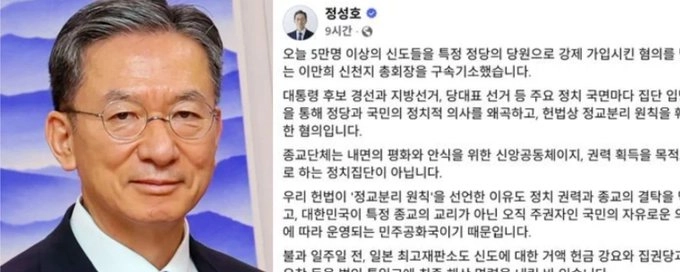
On June 30, South Korea's Minister of Justice posted about the case. Lee had been indicted and detained. Strict punishment matching his responsibility was unavoidable, the minister wrote. The post closed with Matthew 7:15: "Beware of false prophets, which come to you in sheep's clothing."
Two problems sit inside that post.
Lee has been indicted. He has not been tried. The minister sits atop the system prosecuting him, and called punishment unavoidable before a judge heard the evidence. That tells the court what answer is expected.
False prophet is a religious category. No criminal code contains it. Once a minister applies it to a named defendant, the state has stopped describing a crime and started describing a faith.
Shincheonji says the church cooperated fully with investigators, and calls the detention a physical punishment on a 95-year-old.
The Pattern Foreign Observers Now Name
Since January, a joint prosecution and police task force has been investigating suspected ties between politicians and religious groups, including Shincheonji and the Unification Church.

On August 7, 2026, five international organizations, Human Rights Without Frontiers, CAP Liberté de Conscience, FOREF, CESNUR, and Bitter Winter, held a press conference at the Seoul Foreign Correspondents' Club and signed a letter calling for Lee's immediate release.
CESNUR managing director Massimo Introvigne said South Korea had crossed a concerning line. He argued the UN Nelson Mandela Rules would call for house arrest rather than imprisonment for a 95-year-old accused of a nonviolent offense, and said the charges were stretched too far legally and conceptually.
Introvigne also applied what he calls the "Law model." Minorities are attacked in three stages: media-driven intolerance, then discrimination by courts and administrators, then persecution and violence.
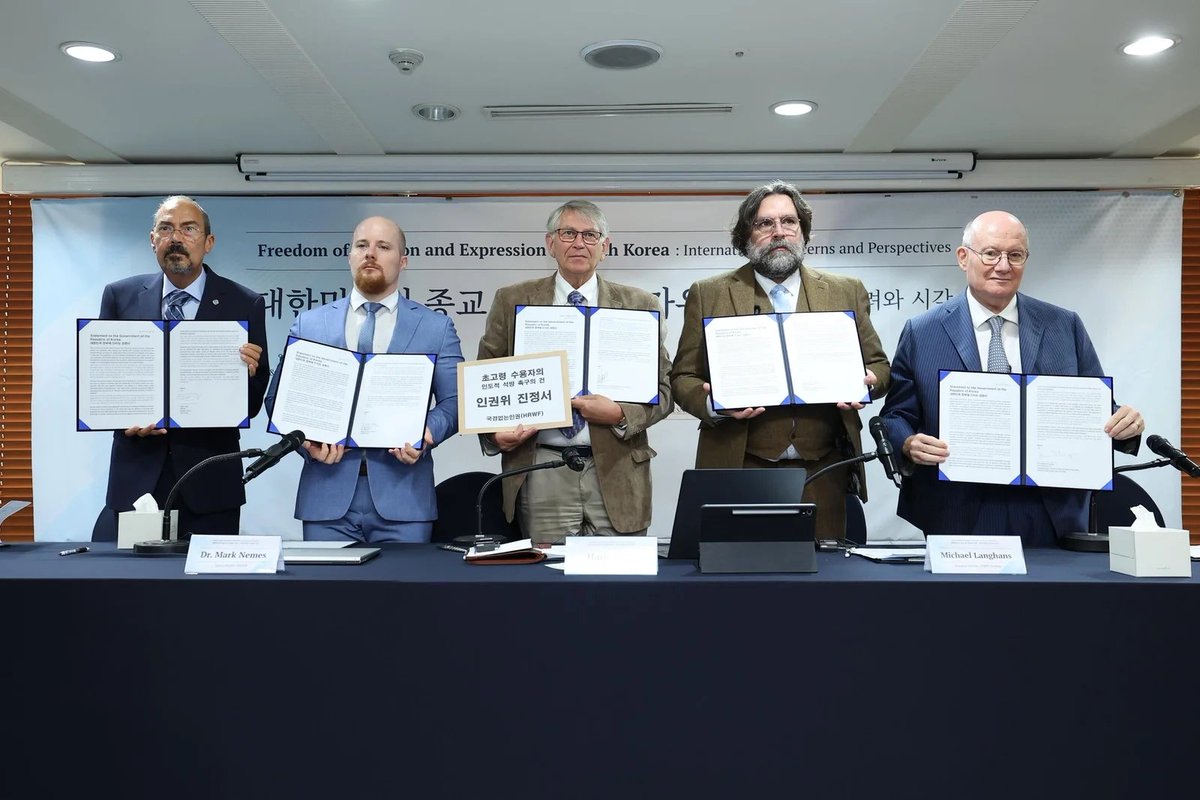
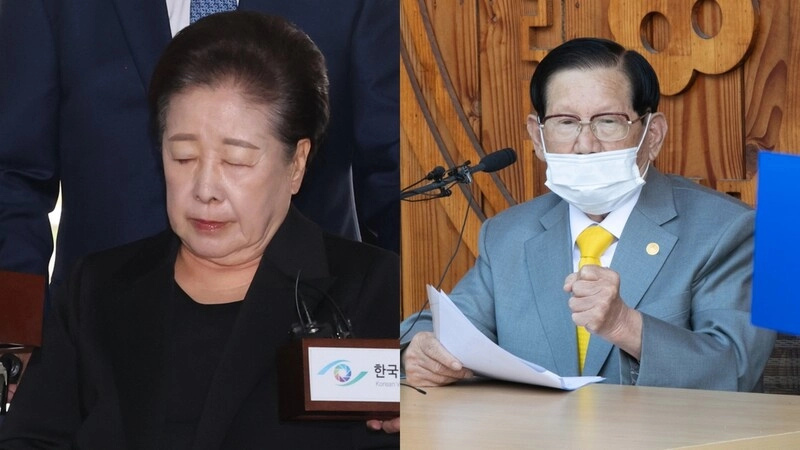
He said the same selective use of election law has now reached Pastor Son Hyun-bo, 83-year-old Dr. Hak-ja Han of the Family Federation, and Lee Man-hee. He warned that forced deconversion has already produced cases in South Korea where believers were badly beaten or killed.
The Principle
If Lee coerced tens of thousands of citizens into registering with a political party, that is a matter for the courts, decided on evidence, with the ordinary protections any 95-year-old defendant would receive.
Nothing in Revelation 7 is a crime.
Mainstream Protestants call a rival reading heresy to defend their own doctrine. That is a theological argument, settled inside churches. A democratic state has no authority to decide which reading of the Bible is orthodox and which is false.
That verdict belongs to churches. It does not belong to a courtroom. Borrowing a rival church's logic of theological exclusion as a pretext for police handcuffs cannot be permitted.
Sources