

A world-renowned religious leader Rev. Sun Myung Moon is incarcerated in a federal prison of the most powerful nation on earth.
The charge: "tax evasion."
But dig beneath the surface, and what emerges is a picture far beyond a tax dispute — one entangled with religion, politics, and race.
And remarkably, this case united Christian leaders of vastly different denominations and ideologies in an unprecedented way.
The Case at a Glance — A $162,000 "Underreporting"
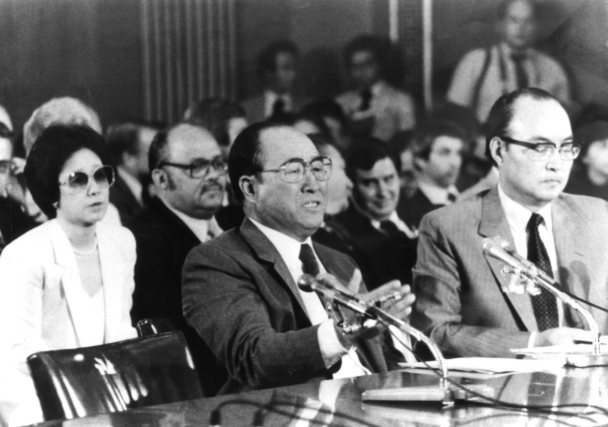
In 1982, the trial "United States v. Sun Myung Moon" commenced.
What His Autobiography Reveals
In his autobiography, As a Peace-Loving Global Citizen, Sun Myung Moon wrote:
"I have been unjustly imprisoned six times — by Imperial Japan, by Kim Il Sung's North Korea, by Syngman Rhee's South Korean government, and even by the United States."
Having endured Japanese colonial imprisonment, forced labor at North Korea's Heungnam concentration camp, and detention in South Korea, he declared that his imprisonment in America was equally "unjust."
On his state of mind behind bars, he wrote:
"Even in the smallest grain of sand, the principles of the world are contained, and there is harmony of the universe. Nothing was born outside the heart of God" — he never lost his inner peace, no matter the circumstances.

Why Is This Called a "False Charge"? — Three Key Arguments
【Argument 1: "Church Funds" or "Personal Assets"?】
At the heart of the prosecution was a simple question: whose money was it?
The U.S. Senate Subcommittee later stated:
"We accused a newcomer to our shores of criminal and intentional wrongdoing for conduct commonly engaged in by a large percentage of our own religious leaders — namely, the holding of church funds in bank accounts in their own names. We charged a non-English-speaking alien with criminal tax evasion on the first tax returns he filed in this country."
The report concluded that Moon was not given a fair chance to understand the law, was not offered civil penalties first, and was not given the benefit of the doubt.
Its verdict: "Injustice rather than justice has been served."
【Argument 2: A "Foregone Conclusion"】
The U.S. Department of Justice offered a deal: "Return to Korea permanently, and the prison sentence will be waived."
Moon refused.
"It must be God's will that I go to prison. There must be a providential reason why I must go this way."

【Argument 3: The Paradoxical Outcome of Imprisonment】
At Danbury, Moon served as a model prisoner.
Former inmate Ed Farmer testified:
"Reverend Moon was jailed on questionable charges and served his sentence with exemplary forbearance."

Ironically, the imprisonment raised the profile of the Unification Church and accelerated Moon's global peace initiatives — including his advocacy for reconciliation between communism and democracy, and his historic meeting with North Korean President Kim Il Sung.
Unity Across Denominations — How Christian Leaders Came Together
The most remarkable aspect of the Moon case is the unprecedented solidarity it sparked across the American Christian world.
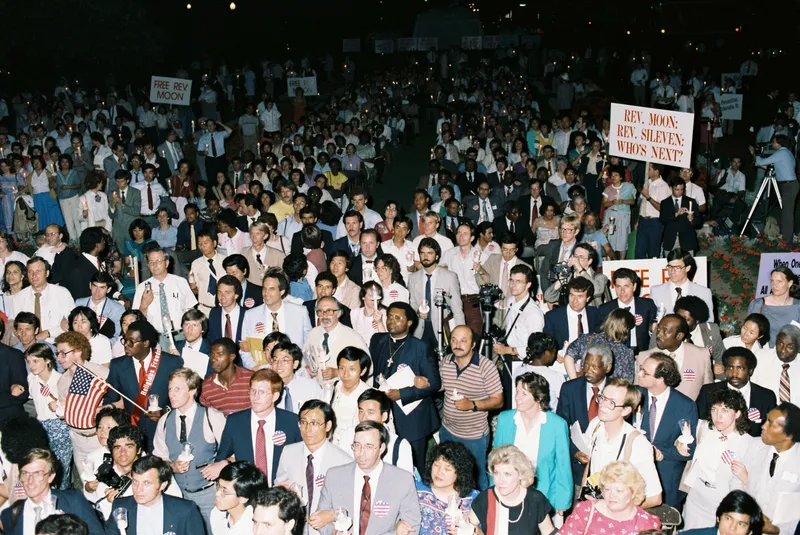
Conservative and liberal, Black and white, Protestant and Catholic — forces that typically found themselves at odds united on a single point: religious freedom.
40 Organizations Representing 160 Million Americans Petitioned the Supreme Court
After the conviction, Moon's side appealed to the U.S. Supreme Court.
More than 40 religious, civil rights, and legal organizations filed amicus curiae (friend of the court) briefs seeking to overturn the conviction.
Key organizations that filed briefs:
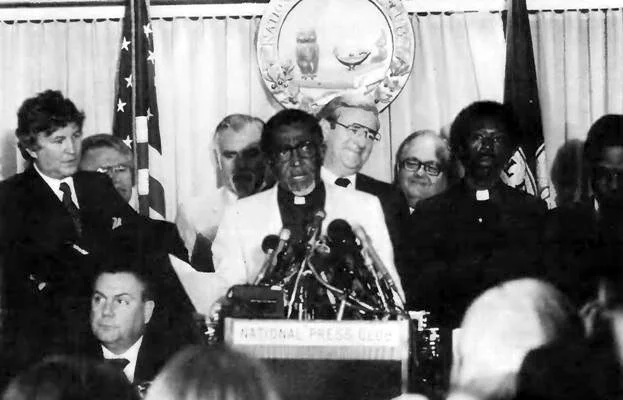
Even secular organizations recognized this case as "a threat to all religions."
Conservative Leaders and Civil Rights Leaders Joined Hands
Christian leaders from politically opposite ends of the spectrum raised their voices together.
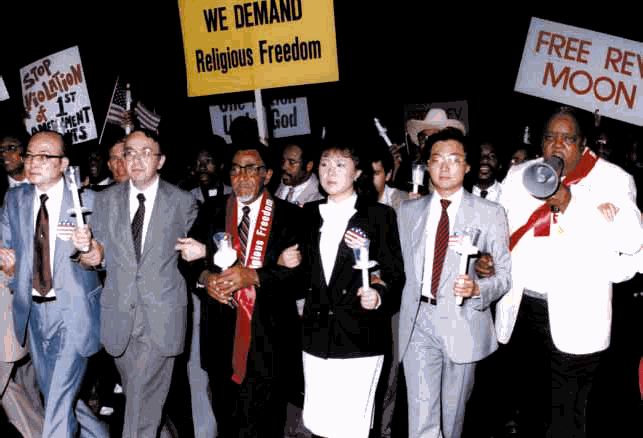
The two men agreed on almost nothing else. Yet they stood on the same platform — an extraordinarily rare sight even in American religious history.
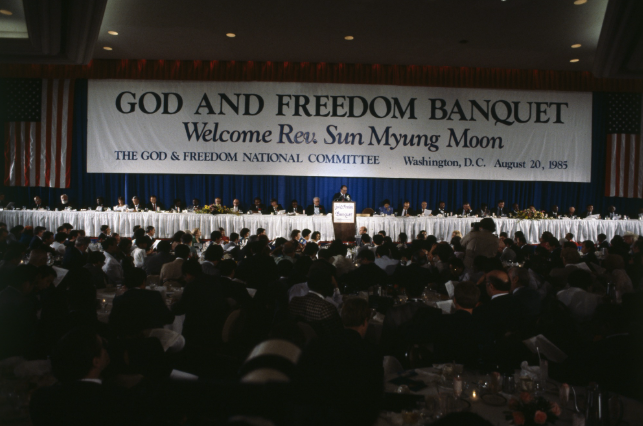
Thousands of Clergy Declared "We Will Go to Prison Together"
The "Common Suffering Fellowship" was born.
Thousands of ministers from across the country signed declarations volunteering to go to prison on Moon's behalf.
They recognized a shared structure between the racial discrimination they had fought and the religious discrimination Moon was facing.
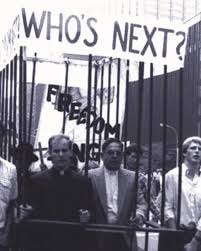
William Raspberry, prominent Washington Post columnist, asked:
"Why are these people, whose judicial concerns tend towards the legal rights of poor Blacks, moved to support a controversial Korean nearly all of whose American followers are white?"
The answer was clear: It is Reverend Moon today, but it could be any of us tomorrow.
Clergy Flooded Danbury
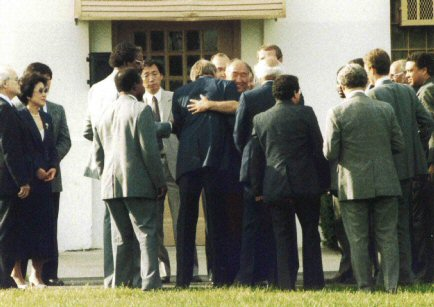
Throughout Moon's imprisonment, clergy from across the nation visited him in an unending stream.
The flood of replies overwhelmed the local Danbury post office. The prison had to assign additional staff solely to handle Moon's mail.
Why Did the Christian World Mobilize to This Extent?
The answer was simple: "We could be next."
If managing church funds in a personal account could lead to criminal prosecution, nearly every small church in America was at risk.
Many clergy concluded that targeting a specific religion — especially a new or minority faith — sets a precedent threatening all religions.
This was not just the Unification Church's problem. It was a challenge to religious freedom itself in America.
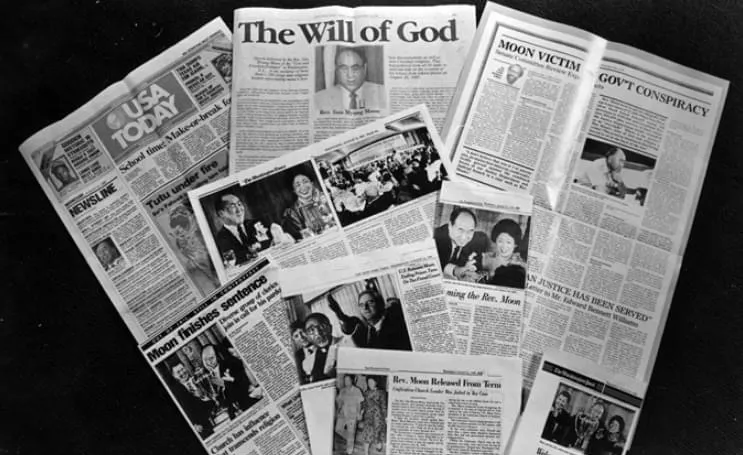
Pulitzer Prize-winning journalist Carlton Sherwood, in his 1991 book Inquisition, condemned the case as "one of the worst instances of religious and racial persecution in American history."
A Faith Without Scars
Looking back on his six imprisonments, Moon wrote in his autobiography:
"Today, no scars remain in my heart. Before true love, wounds are easily healed."
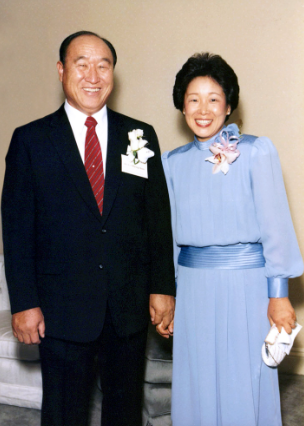
The guilty verdict remains a historical fact.
But when we consider the religious prejudice and political intent behind it, this case cannot be dismissed with the simple label of "tax evasion."
Above all, it is the unity of clergy — transcending denomination, race, and political affiliation — that speaks most eloquently to the true nature of this case.
If it had been a straightforward tax matter, why would more than 40 organizations representing 160 million people have petitioned the Supreme Court, and why would thousands of ministers have declared their willingness to go to prison together?
For Sun Myung Moon, the 13 months at Danbury were a trial of faith.
Yet that trial compelled the American Christian world to reexamine the meaning of religious freedom — and became a turning point that propelled Moon's global peace movement forward with even greater force.
Sources
◆ Court Records & Legal Documents (Highest Reliability)
◆ Encyclopedias & Academic Archives (Neutral Third-Party Descriptions)
◆ Media Reports (Contemporary News)
◆ Books (Cited within Articles)
◆ Unification Church Related Materials (Useful Primary Sources, though Biased)
◆ Criticism & Third-Party Analysis