

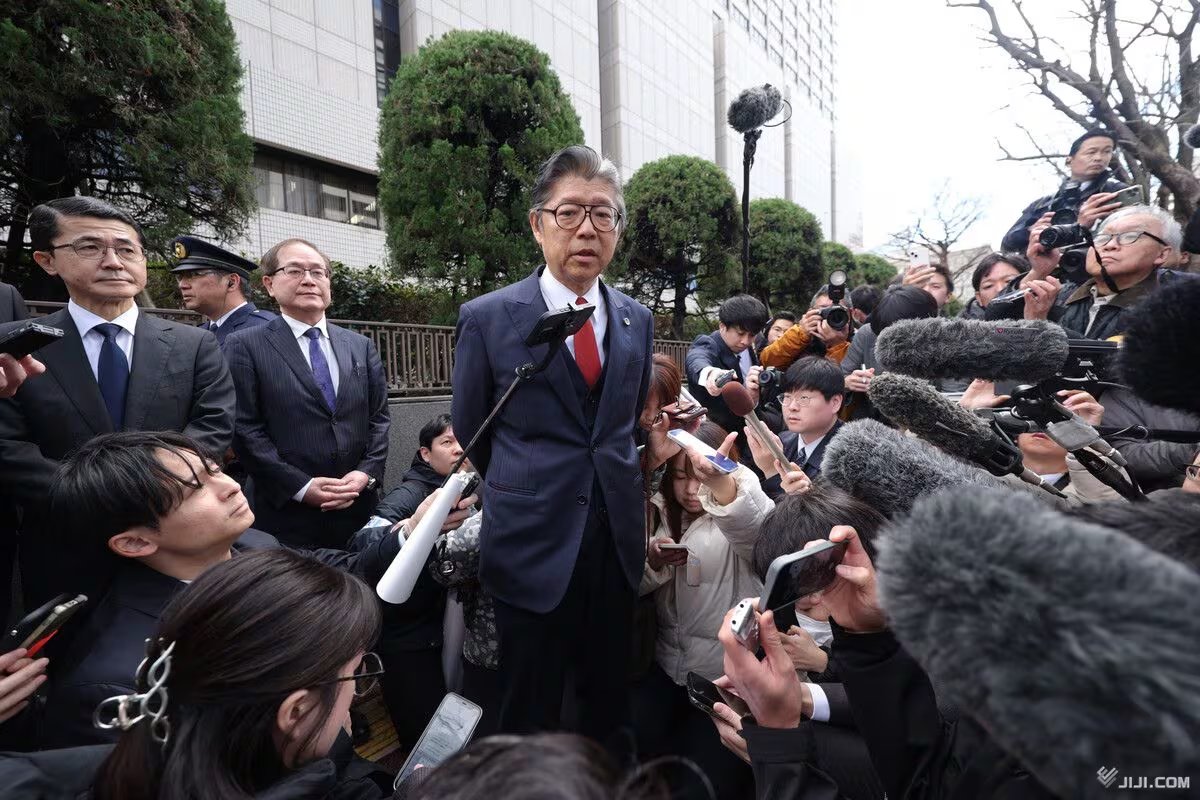
On March 4, the Tokyo High Court upheld the dissolution order against the Family Federation for World Peace and Unification — formerly the Unification Church. After a year-long legal battle, a court-appointed liquidator was named that same day.
The organization will file a special appeal to the Supreme Court. If the ruling is overturned, proceedings would halt — but constitutional violations are the primary grounds required, and the bar is extremely high.
The Political and Emotional Climate Behind the Ruling
The move toward dissolution did not follow any change in the organization's conduct.
It followed a killing.
The 2022 assassination of former Prime Minister Shinzo Abe triggered a wave of media outrage that reshaped Japan's political landscape overnight. Fact-checking of suspect Tetsuya Yamagami's stated motive has shown that his family's financial difficulties were not caused by the church alone. That context was largely set aside.
The Practical Suppression of Religious Activity
Presiding Judge Motoko Miki stated the dissolution was "necessary and unavoidable, even taking into account the impact on the religious freedom of believers." The court says believers' religious activities will not be restricted.
But assets are now frozen.
Securing a place to gather is no longer straightforward. Without an organizational structure, without facilities, without funds — the ability to practice faith collectively is gone in practice, even if it remains on paper.
What Changed the Moment the Ruling Took Effect
From the moment the High Court issued its decision:
The liquidator is now the sole legal representative of the organization.
No church officer, no board, no voice from the membership can override his decisions.
Assets Subject to Liquidation
The Family Federation's assets across Japan have effectively become the source of funds for victim compensation.
What Members Are Facing
Japan's Family Federation has an estimated 600,000 believers.
The impact began the moment the ruling was handed down.
Within hours, lawyers representing the liquidator visited the headquarters and local churches to begin handover proceedings. At some facilities, members were told they would not be able to enter "for the time being starting tomorrow."
Church keys, vehicles, and everything within were handed over — all now under the liquidator's control.
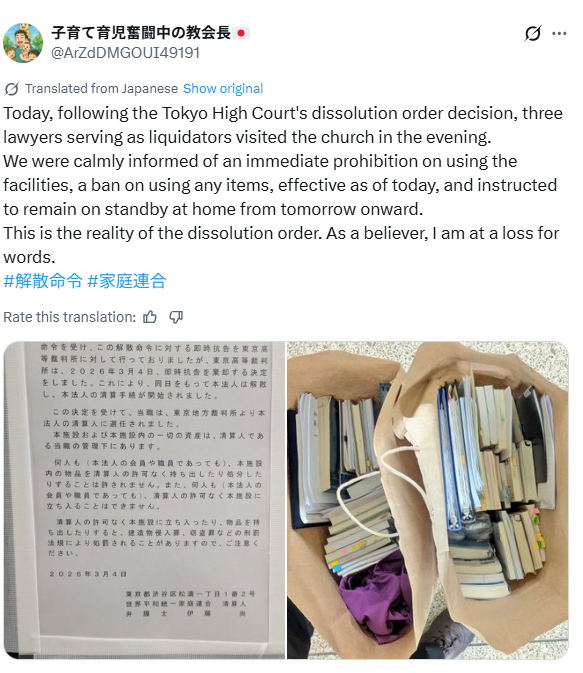
At the entrance of each church, a notice was posted: anyone who enters without the liquidator's permission, or removes items from the premises, may face criminal charges — including trespassing and theft.
Just hours earlier, these were places of worship.
Places people came to in faith.
The Family Federation can continue as a voluntary organization.
But since the March 2025 district court order, the group has already been refused access to public and private facilities, with cases of volunteer activities being turned away as well.
This kind of social exclusion must not be allowed to continue.
No Clear Timeline for Completion
The liquidation has no defined endpoint.
The scale of assets is large, and the number of verified victims has not been finalized.
Proceedings could take several years.
Throughout this period, all facilities remain under the liquidator's control.
Japan's Religious Corporations Act contains almost no rules governing this kind of liquidation.
Even the Japan Federation of Bar Associations has acknowledged the provisions are "extremely sparse."
MEXT guidelines issued in October 2025 require the liquidator to compensate not only those who filed claims within the standard period, but anyone who comes forward afterward. Constitutional law expert Seishiro Sugihara warns that distributing assets based solely on unverified, self-reported claims risks violating property rights guaranteed under Japan's constitution.
Where the Remaining Assets Go
Minister of Education Announces Something Remarkable
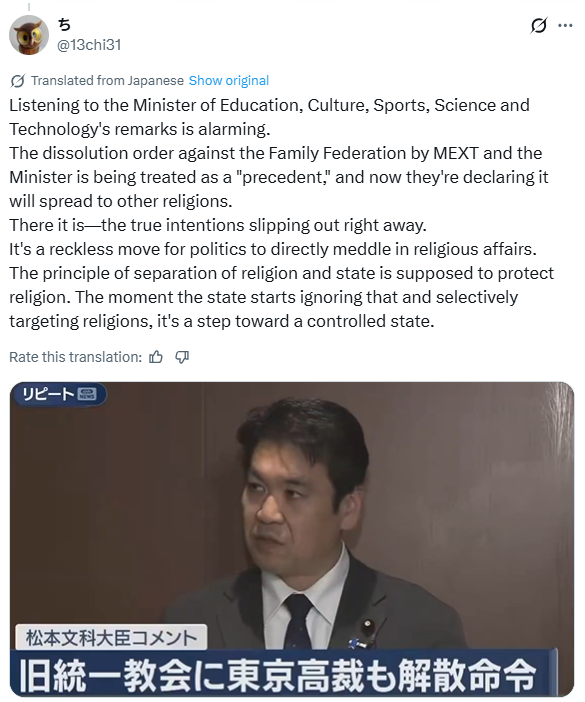
Following the ruling, Minister of Education Matsumoto said something remarkable.
"The court has established that illegal fundraising and solicitation can constitute grounds for a dissolution order. We will share this standard with prefectures nationwide, and if similar conduct is found in other religious corporations, we will respond accordingly."
In other words — today's ruling is a precedent. Every religious organization across the country is now subject to the same scrutiny.
Is this not a constitutional violation?
The principle of separation of church and state exists to protect religion from state interference. Both Japan and South Korea appear to be interpreting that principle in reverse.
The state selecting, monitoring, and intervening in religion — this should never happen.
We have seen where this leads in history.
We must not go there again.
Japan Ignored the Warning From the International Community
In October 2025, four UN Special Rapporteurs issued a joint statement:
this dissolution proceeding raises serious concerns under the International Covenant on Civil and Political Rights — the treaty that protects freedom of religion.
They flagged the use of vague standards like "public welfare" and "social appropriateness" as grounds for dissolution. They called on Japan to revise its guidelines and cooperate with UN mechanisms.
The High Court dismissed every warning, concluding the dissolution "does not violate the ICCPR."
Jan Figeľ (@janfigel), the EU's first Special Envoy for Freedom of Religion or Belief, called the ruling "arbitrary, unconstitutional, and unlawful."
Former U.S. Ambassador-at-Large Sam Brownback (@SamuelBrownback) warned it "will have a chilling effect on all religions in Japan and throughout Asia."
It is also worth noting: Italy's Constitutional Court struck down a "mental manipulation" criminal provision in 1981, ruling that influence between people cannot be objectively measured. The same criticism applies to the mind control theory used as a basis for this dissolution.
What Remains: Faith and the Faithful
This process will fundamentally alter the landscape of religious practice for hundreds of thousands of believers.
Throughout the legal and political sequence that led here, the believers themselves had no choice in the matter.
They will continue in their faith.
We hope the world will come to know the truth of what led to this ruling — and that what has unfolded in Japan is never used as a precedent to be exploited elsewhere.
This ruling has long been warned to threaten religious freedom across Asia.
Now, that threat is expanding across Japan itself.
Its effects are already being felt in China and South Korea.
As people who love God, we must stand against this threat.